
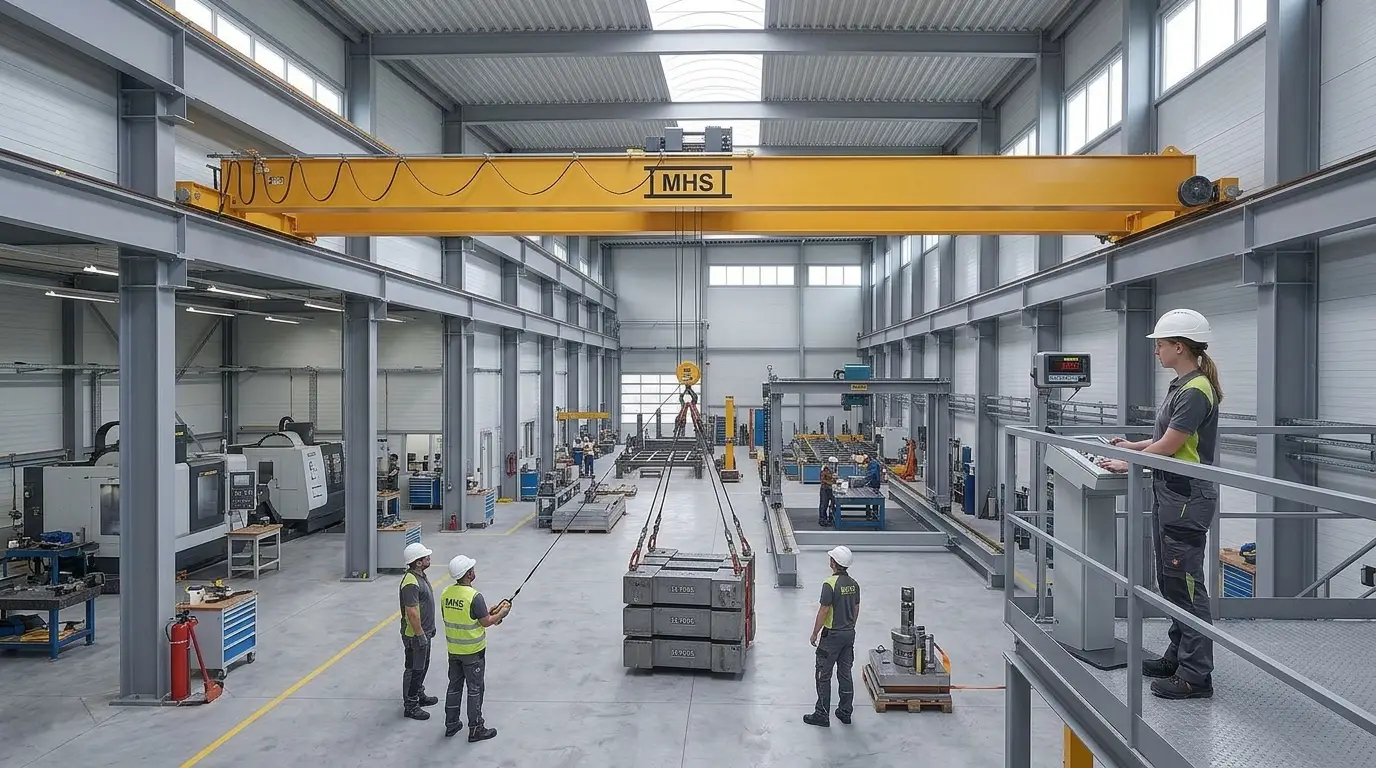
Crane load testing is a controlled test that verifies a crane can lift, hold, and move a known test load safely. For overhead and gantry cranes, OSHA 29 CFR 1910.179 requires new and altered cranes to be tested before initial use and caps the rated test load at 125% of rated capacity unless the manufacturer recommends otherwise. Exact requirements depend on the crane type, the applicable standard, and the reason for the test.
In Short
- A load test verifies rated capacity. An inspection checks the condition. Neither replaces the other.
- OSHA 1910.179 requires testing of new and altered overhead and gantry cranes before initial use.
- The rated test load must not exceed 125% of rated load unless the manufacturer says otherwise.
- OSHA does not set an annual load test for every crane. Inspection intervals are a separate requirement.
- Written test reports must be kept on file and be readily available.
Facilities searching for crane load testing requirements are usually in one of four situations. They are commissioning a new crane, finishing a modification or repair, preparing for an audit, or trying to work out whether an old crane has ever been properly tested. This guide covers what the rules say, what they don’t say, and how to run a defensible test.
This guide is general information, not legal advice. Check the current text of the regulation and your crane manufacturer’s documentation before testing.
What Is Crane Load Testing?
Crane load testing is the process of lifting and moving a verified test load to confirm that a crane’s structure, hoist, brakes, and travel systems perform safely at their rated capacity.
An overhead crane load test answers a question an inspection can’t: does the crane actually perform under load?
A visual check can show a cracked weld or frayed rope, but it can’t show whether a hoist brake holds a full load or whether the girder deflects within design limits. Load testing of lifting equipment provides that proof.
It also gives you a performance baseline. When a test report records how the crane behaved at commissioning, later problems are much easier to diagnose.
A load test has limits. It does not replace weld inspection, fatigue evaluation, or a review of the runway and building structure. It confirms performance on test day, under the test conditions.
What Are the OSHA Crane Load Testing Requirements?
Under OSHA 1910.179, new and altered overhead and gantry cranes must be tested before initial use by or under the direction of an appointed person. The rated test load may not exceed 125% of rated load unless the manufacturer recommends otherwise, and written test reports must be kept on file.
The OSHA crane load testing requirements for overhead cranes sit in the testing provisions of 1910.179. They break down into a few parts:
| Requirement | What It Means in Practice |
| Operational testing before initial use | New and altered cranes are tested for hoisting and lowering, trolley travel, bridge travel, and limit, locking, and safety devices |
| Rated load test | A test with a known load is performed to confirm the crane’s load rating |
| Test load ceiling | The rated test load must not exceed 125% of rated load unless the manufacturer recommends otherwise |
| Minimum test movements | The test includes holding the load on the hoist brakes, trolley travel along the bridge, and bridge travel along the runway |
| Written report | A report from the appointed person confirms the load rating |
| Recordkeeping | Test reports are kept where designated personnel can readily reach them |
Three points are easy to miss.
First, 1910.179 sets a ceiling on the test load, not a fixed percentage. Many programs use 100% to 125% of rated capacity, guided by the manufacturer and ASME B30 requirements, but the regulation itself only caps the figure.
Second, the standard covers overhead and gantry cranes. Mobile cranes, construction cranes, derricks, and other equipment fall under different OSHA rules. Check that 1910.179 applies to your crane first.
Third, a company’s own load testing policy or an insurer’s requirement can be stricter than OSHA. Those requirements are real, but they aren’t OSHA mandates.
Crane Load Test Requirements and Standards
Crane load test requirements come from layered sources: OSHA regulations, ASME B30 standards, CMAA guidance, and the crane manufacturer’s instructions. The correct set depends on the type of equipment being tested.
OSHA Requirements for Overhead Cranes
OSHA 1910.179 is the baseline for overhead and gantry cranes in general industry. It sets what must be tested before initial use, caps the test load, and requires documentation. It also defers to the manufacturer on test loads above 125%, so the OEM manual should be part of every test plan.
Applicable Crane Load Test Standards
ASME B30 standards add detail that OSHA leaves open. Which volume applies depends on the equipment:
| Equipment | Typical Standard |
| Overhead and gantry cranes (top-running bridge, trolley hoist) | ASME B30.2 |
| Underhung and monorail cranes | ASME B30.11 |
| Overhead hoists (underhung) | ASME B30.16 |
| Top-running single girder cranes | ASME B30.17 |
| Below-the-hook lifting devices | ASME B30.20 |
| Lever-operated hoists | ASME B30.21 |
| Professional services on cranes and monorails | CMAA Specification 78 |
Check the edition your facility or jurisdiction has adopted. Identify the correct standard before the test, because it controls the test load, the movements, and the report contents.
Load Test Requirements for Lifting Devices
A below-the-hook device, such as a lifting beam, vacuum lifter, or magnet, is not the same as the crane that carries it. Its test requirements usually come from its own standard (ASME B30.20 and the manufacturer’s data) and from its own rated capacity. Never assume the crane’s test satisfies the attachment, or the other way around. For a crane that handles rigging gear daily, keep separate records for each.
When Is Crane Load Testing Required?
Load testing is typically required or appropriate for new crane installations, altered cranes, re-rated cranes, and any case where the OEM, the applicable standard, or an engineering evaluation calls for it.
| Situation | Load Test Likely Needed? |
| New crane installation | Yes, before initial use under OSHA 1910.179 |
| Crane alteration or modification | Yes, if it counts as an alteration under the standard |
| Change in rated capacity (re-rating) | Yes, to confirm the new rating |
| Repair of load-bearing or structural parts | Often, depending on the repair and manufacturer guidance |
| Crane relocated to a new runway | Often, because the installation changes |
| Routine inspection finding minor wear | Not automatically |
| Brake, hoist, or gearing repair | Judged case by case |
| Replacement of like-for-like small parts | Usually not |
Not every repair or inspection triggers a load test. The question to ask is whether the work could have changed the crane’s ability to carry its rated load. If it could have, test. If you’re unsure, a qualified crane engineer should make the call and document the reasoning.
How Often Should a Crane Be Load Tested?
OSHA 1910.179 does not require every overhead crane to be load tested annually. It requires testing of new and altered cranes before initial use, and it sets inspection frequencies separately.
This is where many facilities get confused. Crane load testing frequency and inspection frequency are different things:
- Frequent inspections run from daily to monthly, depending on the crane’s service.
- Periodic inspections run from 1 to 12 months, depending on the crane’s service.
- Load testing is event-driven under OSHA: new, altered, or otherwise changed cranes.
Some programs add periodic load testing on top of this. A common example is a four-year cycle set by company policy, an insurer, a manufacturer, or a state plan. Those intervals are legitimate program choices, but they aren’t an OSHA federal mandate. Look for the requirement in the source document and don’t quote it as OSHA law.
To set the frequency for your own crane:
- Check the manufacturer’s manual for recommended intervals.
- Check your state OSHA plan, insurer, and internal safety policy.
- Review the crane’s service class and how heavily it’s used.
- Pull up prior test reports to see when it was last tested and under what conditions.
- Ask a qualified crane professional to confirm the interval and document it.
Who Can Perform a Crane Load Test?
OSHA 1910.179 requires the test to be done by or under the direction of an appointed person, who provides a written report confirming the crane’s load rating.
In practice, that person should be qualified for the specific equipment: trained in crane mechanics and safety, familiar with the OEM and applicable standards, and able to judge whether the crane’s behavior is acceptable. Many facilities hire a crane service company with certified inspectors and calibrated equipment instead of running the test in-house.
Whoever performs it should have authority to stop the test. Operators, riggers, and a signal person also have defined roles. A load test with unclear responsibilities is a safety risk, not only a paperwork risk.
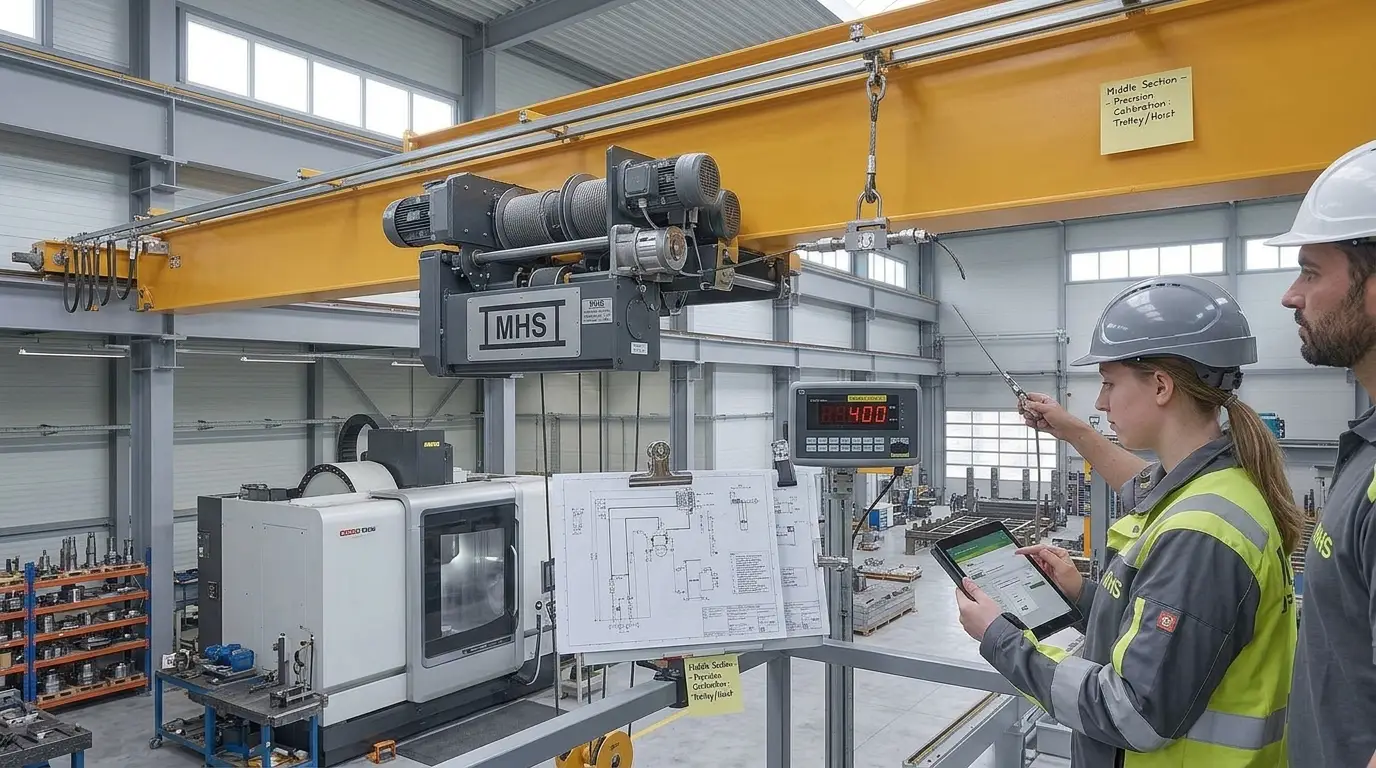
Crane Load Testing Procedure: Step by Step
A crane load test normally follows five stages: confirm rated capacity, inspect the crane, set the test load, run the test, and document the results. The exact steps depend on the crane type, the OEM, and the applicable standard.
1. Review the Crane’s Rated Capacity
Confirm the nameplate rating, the hoist configuration, and any auxiliary hoist ratings. Auxiliary hoists have their own capacity and are tested on their own. Gather the OEM manual and the applicable standard before anything is lifted.
2. Inspect the Crane Before Testing
Inspect hooks, wire rope or load chain, brakes, limit switches, controls, end trucks, trolley frames, and runway structures. Check the crane’s structural integrity where loads concentrate, such as girder connections and wheel assemblies. Fix unsafe conditions first. Never load test a crane with a known defect.
3. Determine the Test Load
Set the test load from the applicable requirement. Count everything on the hook, including slings, spreaders, and hook blocks. Stay within the OEM’s limit and the 125% ceiling for overhead cranes under OSHA. Verify the weight of the load itself, not just the nominal weight.
4. Conduct the Load Test
Under OSHA, the minimum operations include:
- Lifting the test load a short distance to confirm the hoist brakes hold it
- Traveling the load the full length of the bridge with the trolley
- Traveling the load the full length of the runway in both directions, with the trolley in as many positions as needed to cover the whole travel
- Lowering the load and confirming the brakes hold it again
Throughout, the test team watches for abnormal noise, brake slip, uneven travel, excessive girder deflection, and any limit switch or safety device that fails to act. They also test the hoist limit switches and the safety and locking devices as part of the trial.
5. Evaluate Results and Document Findings
Record what happened, including anything abnormal. Note corrective actions and whether retesting is needed. Then complete the written report (covered below).
After the test, do a post-test inspection. A crane that has just carried 125% of its rating should be checked for deformation, loosened fasteners, wire rope disturbance, and brake wear before it goes back to production.
What Are Crane Load Test Weights?
Crane load test weights are known, verified loads used to apply the required test load. Their weight must be certain, because an unverified weight makes the whole test unreliable.
| Test Method | How It Works | Watch Out For |
| Certified test weights | Calibrated blocks with documented weights | Transport and rigging weight must be counted |
| Water bags | Filled bags weighed with a calibrated load cell | Needs accurate fill measurement and secure rigging |
| Load cell in line | A calibrated cell between hook and load shows applied weight | Cell calibration must be current |
| Portable load test stands | Stands for testing hoists or small lifting equipment | Confirm the stand’s own rating |
| Production loads with known weights | Equipment or material whose weight is documented | Don’t use guessed or nominal weights |
Rated capacity and test load are not the same number. The rated capacity is what the crane is allowed to lift in service. The test load is what’s applied during the test, which may equal or exceed the rating (never more than 125% under OSHA 1910.179 unless the OEM says otherwise).
A common mistake is using concrete blocks or scrap steel with estimated weights. If the weight isn’t verified, an overload could be much larger than intended, or the test could be a weaker proof than the report claims.
Static vs. Dynamic Crane Load Testing
Static load testing holds a load stationary to check structure and brakes. Dynamic load testing moves the load through crane motions to check how the crane performs in operation.
These are common industry terms for the two kinds of check inside a load test. OSHA’s wording describes the actions (hold, travel, lower) and doesn’t use the labels, but the ideas map directly.
| Factor | Static Test | Dynamic Test |
| Purpose | Verify the crane supports and holds the load | Verify movement under load |
| Load movement | Held in place | Hoisted, lowered, and traveled |
| What it checks | Brake holding, structural response, deflection | Hoisting, trolley travel, bridge travel, limit devices |
| Typical observations | Brake slip, deflection, hook and rope condition | Smoothness, noise, control response, stopping |
| Risk profile | Lower motion risk | Higher motion risk, needs more clear space |
In practice, most overhead crane rated load tests include both: the hold at the start and end, and the travel in between. How the test is structured, and which elements are required, depends on the OEM, the standard, and the scope you agreed on before testing.
Load Testing Hoists, Gantry Cranes, and Other Equipment
Gantry cranes follow the same 1910.179 provisions as overhead cranes, while hoists, portable equipment, and lifting devices are tested under their own standards and manufacturer instructions.
- Gantry cranes: Include the ground rail or wheel path in the test. Travel testing should cover the full rail length.
- Underhung and monorail cranes: Check the standard that applies and the beam’s rated capacity. Support structure matters more because the load hangs from the building.
- Powered hoists: Test brakes and limit switches under load. If a hoist is removed and reinstalled, the installation may need retesting.
- Manual and lever hoists: These are often tested by the manufacturer or with a calibrated tester. Check ASME B30.21 and the OEM instructions.
- Portable hoists: Portable load test stands and hoist load testers let a shop verify capacity away from the crane.
- Below-the-hook devices: Check ASME B30.20 and the device’s markings. Test intervals and procedures differ from the crane’s.
Two cranes that look alike can have different test requirements because their service class, standard, or alteration history differs. Document why a particular approach was chosen.
Crane Load Test Certification and Documentation
A crane load test report is a written record of what was tested, how, and what happened. It is not a government-issued certificate, and OSHA requires test reports to be kept on file and readily available.
A solid crane load test report should include:
- Crane identification (serial number, location, manufacturer)
- Rated capacity and the capacity of any auxiliary hoist
- Test date, location, and conditions
- Test load, how the weight was verified, and rigging weight
- Test procedure and the movements performed
- Results, deflection or brake observations, and limit switch function
- Defects found and corrective actions taken
- Name and credentials of the person directing the test
- Signature and statement confirming the load rating
- Any retest records
Documentation requirements can differ by standard, jurisdiction, insurer, and contract. Some customers ask for a crane load test certification letter. That letter comes from the testing company, and it states what was tested. It shouldn’t be described as an official approval.
Keep these records with the crane’s inspection files. During an audit, a test report that can be pulled in minutes shows the program is real.
What Happens If a Crane Fails a Load Test?
A crane that fails a load test should be taken out of service, evaluated by qualified personnel, repaired as needed, and retested before it returns to production.
- Stop the test safely. Lower the load under control if it’s safe to do so.
- Tag the crane out of service and lock out energy sources per your lockout/tagout program.
- Record exactly what happened. Capture the symptom, location, load, and any readings.
- Find the root cause. Brake wear, structural distortion, electrical faults, and runway misalignment all show up differently.
- Repair using qualified personnel and OEM-matched parts.
- Retest after repair, at the level the standard and engineer call for.
- Update records with the failure, repair, and retest.
A failed test is useful information. It’s far better to find a brake that won’t hold at 100% under controlled conditions than at 100% with workers underneath.
Crane Inspection and Load Testing: What’s the Difference?
A crane inspection evaluates condition, wear, and defects. A load test evaluates performance under a specified test load. They serve different purposes, and neither automatically replaces the other.
| Factor | Crane Inspection | Crane Load Test |
| Purpose | Find wear, damage, and defects | Verify capacity and performance |
| Load applied | None (normal operation or no load) | Known test load |
| Timing | Frequent (daily to monthly) and periodic (1 to 12 months) | Before initial use, after alteration, or as required |
| Output | Inspection record and findings | Test report confirming rating |
| Catches | Cracks, frayed rope, loose parts, wear | Brake slip, abnormal deflection, travel issues under load |
| Misses | Performance under full load | Wear that isn’t active during the test |
A crane can pass an inspection and still have a hoist brake that slips at full load. A crane can pass a load test and still have a cracked part that hasn’t failed yet. Facilities need both.
How to Prepare for an Overhead Crane Load Test
Good preparation prevents most test-day problems.
- Confirm specs. Verify rated capacity, hoist details, and the OEM test instructions.
- Pick the governing standard. Settle OSHA, ASME B30, and company requirements in advance.
- Arrange verified weights. Order certified weights or calibrated load cells and confirm their ratings and calibration dates.
- Plan the rigging. Count every pound on the hook, and inspect slings and spreaders.
- Inspect the crane first. Fix known defects before the test.
- Clear and control the area. Barricade the zone under the load path, and keep non-essential people out.
- Check the runway. Make sure travel paths, bumpers, and clearances are ready.
- Assign roles. Name the test director, operator, signal person, and observers.
- Plan documentation. Prepare the report template and decide who signs.
- Brief the team. Cover stop signals and what happens if something abnormal appears.
For outdoor gantry cranes, plan around wind and ground conditions. Ground that isn’t level or firm can invalidate a test.
Common Crane Load Testing Mistakes
- Treating the annual inspection as a load test. They’re different checks with different purposes.
- Using unverified test weights. Estimated weights make the result meaningless and can overload the crane.
- Forgetting rigging weight. Slings, spreaders, and the hook block all count.
- Testing a crane with a known defect. Inspect and repair first.
- Skipping the full runway travel. A test that doesn’t cover the whole path can miss a localized runway problem.
- Ignoring the OEM. The manufacturer can recommend a different test load than the default.
- Not testing auxiliary hoists. They carry separate ratings.
- Weak documentation. A test with no report doesn’t help in an audit.
- Assuming a repair always needs a test, or never does. Judge by what changed.
How Long Does a Load Test Take, and What Affects the Cost?
A routine overhead crane load test is often completed in a few hours to a day, while larger cranes, multiple hoists, and complex rigging take longer. Cost depends on crane size, test weights, location, and scope.
Factors that move the schedule and price:
- Crane capacity: Heavier test loads need more weight, more rigging, and more handling.
- Number of hoists and cranes: Each hoist is tested on its own.
- Test weight logistics: Delivering and moving large certified weights is often the highest cost.
- Access and site conditions: Outdoor yards, tight bays, and operating plants complicate planning.
- Scope: A load test alone costs less than a combined inspection, test, and repair job.
- Downtime: Production stops while the crane is tested, so schedule tests around shutdowns where you can.
Combining a load test with a periodic inspection and any required repairs often reduces total downtime.
Professional Crane Load Testing Services from MHS Crane
A load test is only as reliable as its planning: the right standard, verified test weights, a qualified test director, and a report you can defend in an audit. MHS Crane provides crane load testing services backed by technical expertise and complete testing documentation. We can combine testing with inspection, repair, and modernization work to cut downtime.
Contact MHS Crane to assess your crane testing needs, or request a load testing quote.
Frequently Asked Questions
Q: What are the OSHA crane load testing requirements?
A: OSHA 1910.179 requires new and altered overhead and gantry cranes to be tested before initial use. The rated test load may not exceed 125% of the rated load unless the manufacturer recommends otherwise. Written test reports must be kept on file and readily available.
Q: How often should an overhead crane be load tested?
A: OSHA does not require every overhead crane to be load tested annually. Testing is required for new and altered cranes, while inspections follow separate frequent and periodic intervals. Some programs set periodic load tests by manufacturer, insurer, or company policy, so confirm which applies to your crane.
Q: What percentage of rated capacity is used for a crane load test?
A: OSHA 1910.179 caps the rated test load at 125% of rated load unless the manufacturer recommends otherwise. Programs commonly use 100% to 125%, guided by the OEM and the applicable ASME B30 standard. This ceiling applies to overhead and gantry cranes, not to every type of lifting equipment.
Q: Is load testing required after crane repairs?
A: Not always. A load test is generally needed after alterations, re-rating, or repairs that could affect load-bearing parts, brakes, or structure. Minor like-for-like repairs often don’t require one, so check the standard, the OEM guidance, and a qualified engineer’s judgment.
Q: What is the difference between static and dynamic load testing?
A: A static test holds a load in place to check the structure and brakes. A dynamic test moves the load through hoisting, lowering, trolley, and bridge travel to check performance in motion. Most overhead crane rated load tests combine both elements.
Q: What is included in a crane load test report?
A: A report should list the crane identification, rated capacity, test date, test load and how it was verified, procedure, and results. It should also note defects, corrective actions, and the name of the person who directed the test. The report is a record, not a government-issued certificate.
Q: Is crane load testing the same as crane inspection?
A: No. An inspection evaluates condition and finds wear or damage, while a load test checks performance under a known test load. Neither replaces the other, and each has its own requirements and timing.
Q: Are load testing requirements the same for all lifting devices?
A: No. Below-the-hook devices, hoists, and portable lifting equipment follow their own standards, such as ASME B30.20, B30.16, and B30.21, and the manufacturer’s instructions. Don’t assume a crane’s test requirements apply to attachments or portable hoists.
Q: Who can perform a crane load test?
A: OSHA requires the test to be done by or under the direction of an appointed person who provides a written report. That person should be qualified for the specific crane and standard. Many facilities hire a crane service company with calibrated equipment and certified inspectors.
Q: Do hoists need their own load test after installation or repair?
A: Often yes. A hoist that is newly installed, reinstalled, or repaired in load-bearing components may need testing under its manufacturer’s instructions and the applicable standard. Auxiliary hoists are tested separately from the main hoist.