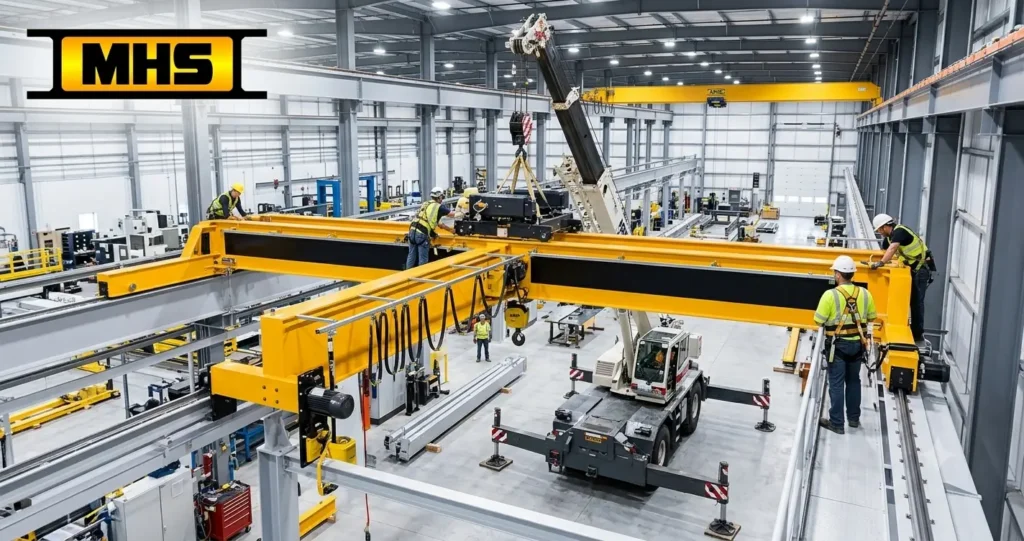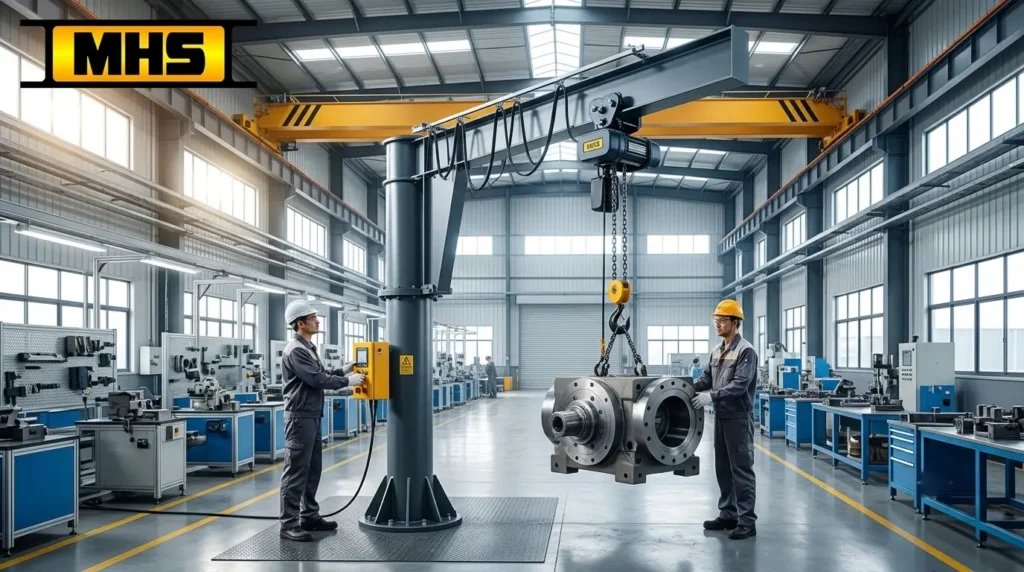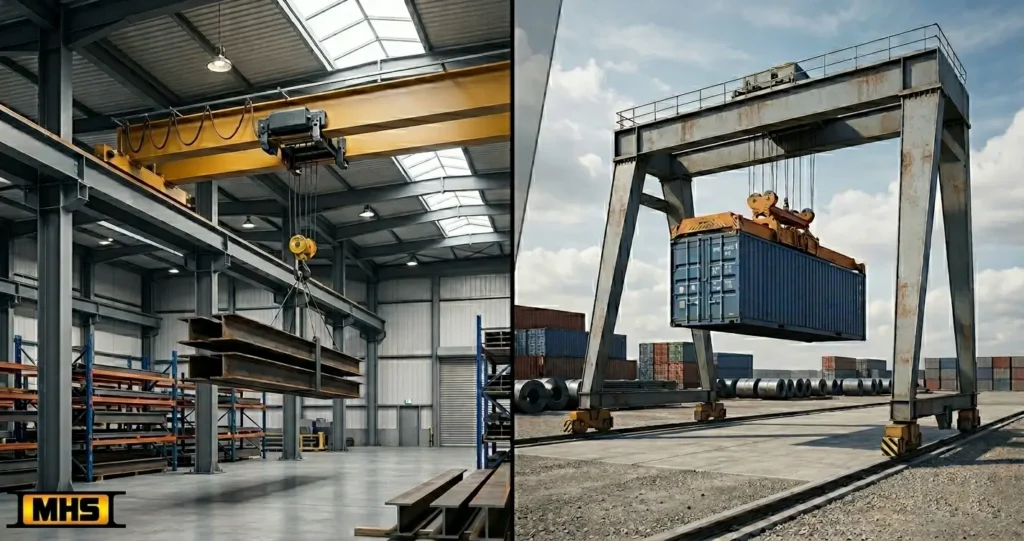
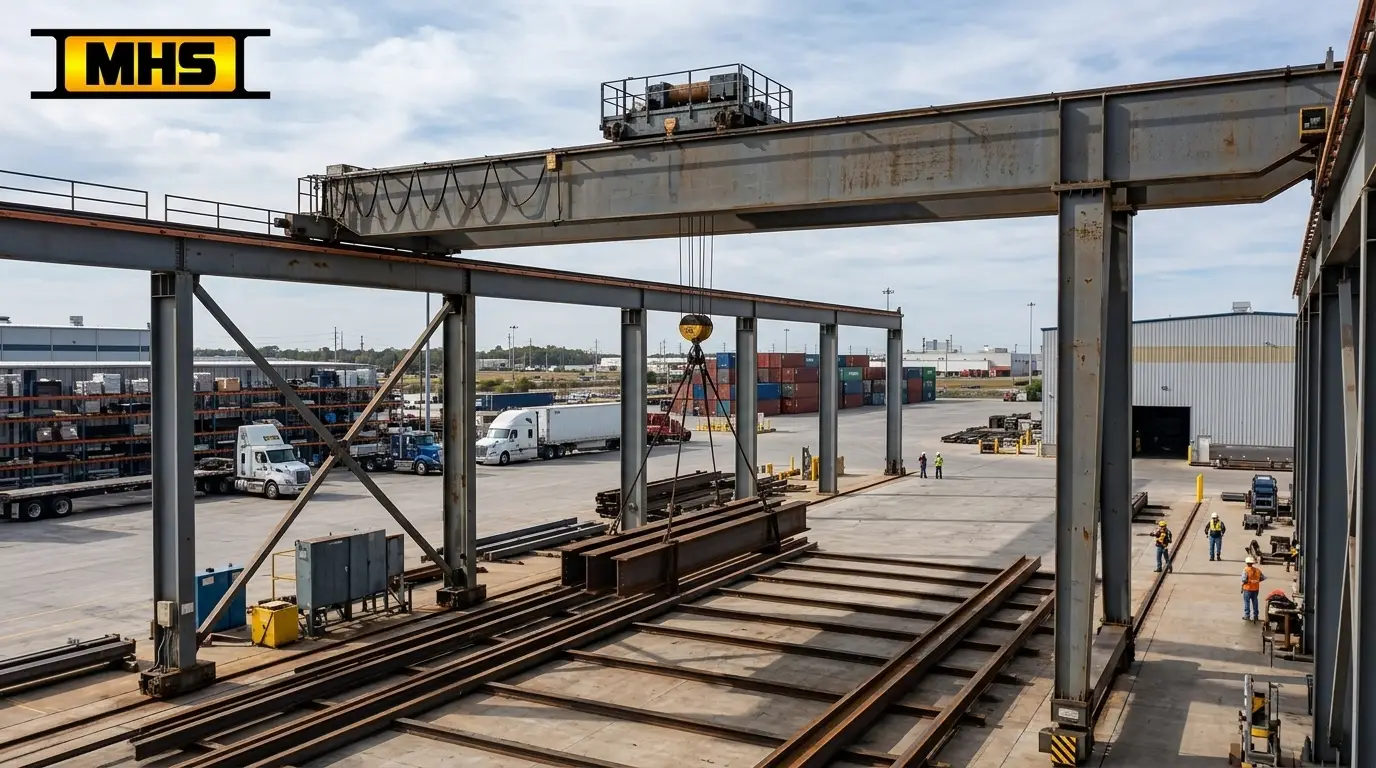
A gantry crane is a lifting system supported by freestanding legs that travel along rails, wheels, or tracks, and is used to lift and move heavy materials without relying on a building’s structural support.
TL;DR:
- Freestanding design means no building structural support required
- Five main types: full, semi, portable, adjustable, and mobile gantry
- Common in construction, shipyards, steel yards, and warehouses
- Capacity and mobility trade-offs drive which type fits a given facility
Unlike an overhead bridge crane, which mounts to a building’s runway beams or ceiling structure, a gantry crane’s legs carry the full load down to the ground or a dedicated rail system. This makes it a common choice for outdoor sites, temporary installations, and facilities where reinforcing the building isn’t practical or cost-effective.
How Does a Gantry Crane Work?
A gantry crane works by supporting a horizontal bridge beam on two vertical legs, which travel along ground-level rails or wheels, while a hoist and trolley move along the bridge to position and lift loads.
The bridge beam spans between the two legs and carries the trolley and hoist assembly. The trolley moves side-to-side across the bridge, while the entire gantry structure, including the legs and bridge together, travels along its rail or track system to cover the length of the work area.
Load handling process:
- Operator positions the gantry along its rail path to the load location
- Trolley moves across the bridge to align the hoist directly above the load
- Hoist lowers, attaches to the load, and lifts it clear
- Gantry and trolley reposition to move the load to its destination
- Load is lowered and released at the target point
Control systems range from manual pendant controls on smaller units, to electric push-button pendants on mid-size systems, to radio remote controls on larger industrial and outdoor gantry cranes where operator sightlines matter.
Gantry Crane Types Explained
Gantry cranes are classified by structure and mobility into five main types — full gantry, semi gantry, portable, adjustable, and mobile — each suited to different capacity and flexibility needs.
| Type | Support Structure | Best For | Typical Capacity Range |
| Full gantry | Both legs on ground rails | Heavy industrial, fixed paths | High (multi-ton) |
| Semi gantry | One leg on runway beam, one on ground rail | Facilities with partial structural support | Medium-High |
| Portable | Casters or wheels, no rails | Workshops, maintenance bays | Low (under 5 tons typically) |
| Adjustable | Height/span adjustable frame | Small facilities, varied load sizes | Low-Medium |
| Mobile | Wheel-based, no fixed track | Job sites needing repositioning | Low-Medium |
Full Gantry Crane
Both legs run on fixed ground rails, making this the standard configuration for heavy industrial applications like steel yards and shipbuilding, where high capacity and repeated travel along a defined path matter more than flexibility.
Semi Gantry Crane
One leg rides a runway beam (using partial building support), while the other rides a ground rail. This hybrid approach reduces the need for a full floor rail system when a facility already has structural support on one side.
Portable Gantry Crane
Built on casters instead of rails, portable gantry cranes are common in workshops and maintenance bays where the crane needs to move between work areas rather than travel a fixed path.
Adjustable Gantry Crane
Height and span can be modified to accommodate different load sizes or workspace configurations — a common choice for smaller facilities that need one crane to serve multiple tasks.
Mobile Gantry Crane
Wheel-based rather than caster-based, mobile gantry cranes are designed for job sites where the crane needs to reposition across uneven or temporary surfaces without a permanent rail system.
A common constraint-driven decision: shops with limited floor space and varying load sizes tend toward adjustable or portable models, while yards with repeated, high-volume lifts along a fixed path use full gantry systems, where capacity and space almost always outweigh cost as the deciding factor.
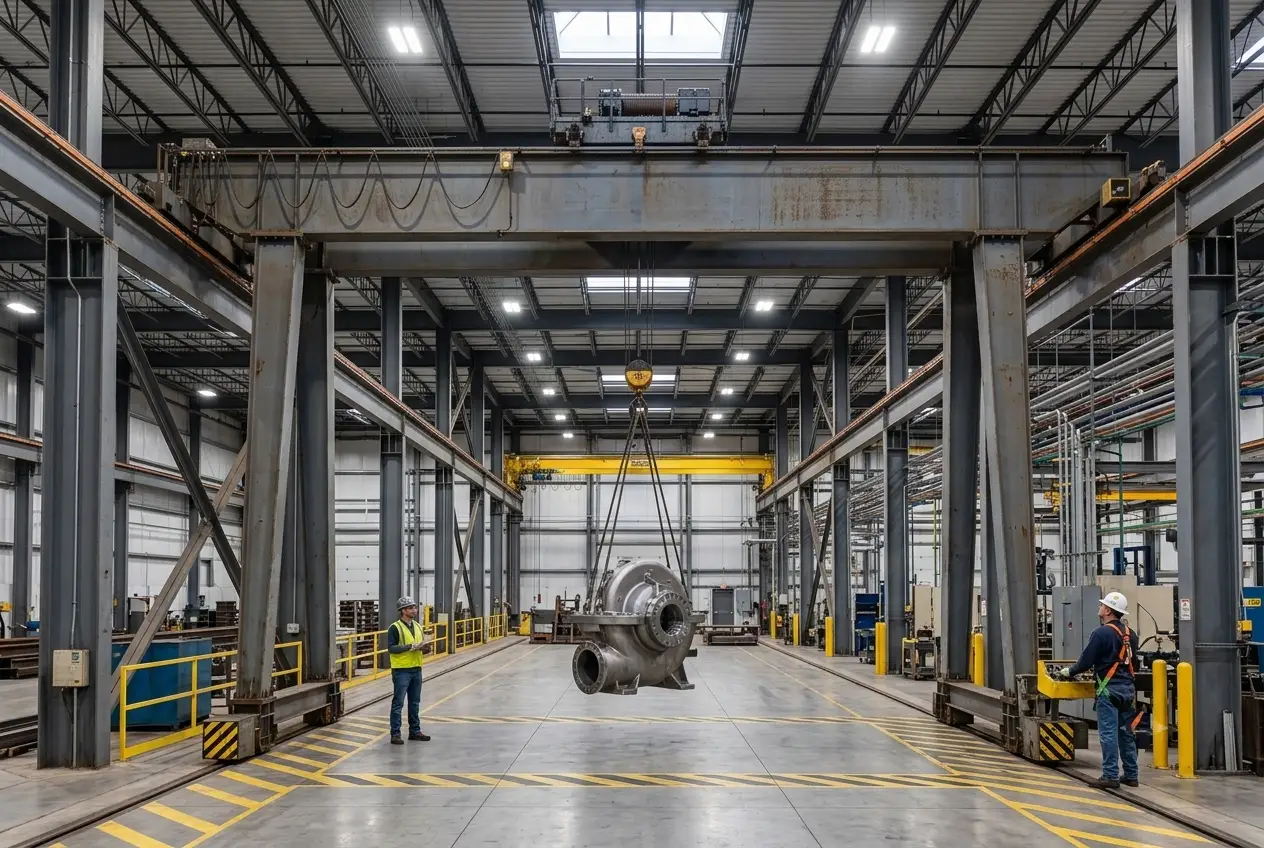
Gantry Crane System and Design
A gantry crane system includes the structural frame, hoist and trolley assembly, end trucks and wheels, control system, and — for permanently installed units — the rail or track system the legs travel on.
Design principles center on three variables: load capacity, span (the distance between legs), and duty cycle (how frequently and intensively the crane operates). A crane engineered for occasional lifts at 50% of rated capacity uses lighter structural members than one running continuous, near-capacity lifts in a production environment — this is why duty classification matters as much as raw capacity when specifying a system.
Material selection typically favors structural steel for the frame, with galvanized or stainless steel components specified for outdoor or corrosive environments (ports, scrap yards) where standard steel would corrode prematurely.
Gantry Crane Components Explained
| Component | Function |
| Frame structure | Supports the bridge and carries load to the ground via legs |
| Hoist system | Provides vertical lifting power (electric, manual, or pneumatic) |
| Trolley system | Moves the hoist horizontally along the bridge |
| End trucks and wheels | Allow the gantry to travel along rails or ground surface |
| Control system | Manual pendant, electric pendant, or radio remote |
| Power supply system | Cable reel, conductor bar, or festoon system for electrified units |
A frequent point of confusion: the hoist and trolley are separate components. The hoist lifts the load vertically; the trolley moves that hoist horizontally across the bridge. Confusing the two leads to miscommunication when specifying replacement parts or troubleshooting movement issues.
Uses and Applications of Gantry Cranes
Gantry cranes are used for lifting and moving heavy materials in construction sites, manufacturing plants, warehouses, steel yards, and shipyards — particularly where building structural support for an overhead crane isn’t available or practical.
- Steel fabrication yards — moving raw steel stock and finished components between workstations
- Shipyards and ports — including rubber tyred gantry (RTG) cranes for container handling
- Construction sites — temporary lifting where permanent structural crane support doesn’t exist
- Warehousing — material handling in facilities without ceiling-mounted runway support
- Heavy equipment maintenance — portable and adjustable units for engine, transmission, and component removal
Port gantry cranes (RTGs) represent a specialized heavy-duty application — designed for continuous, high-capacity container lifting and built for durability under constant outdoor operation, unlike lighter workshop-grade portable units.
Gantry Crane vs Overhead Crane (Key Differences)
The core difference is structural support — a gantry crane’s legs carry the load to the ground or a dedicated rail, while an overhead crane relies on the building’s runway beams or ceiling structure. This is the key distinction in the comparison of Overhead Crane vs Gantry Crane.
| Factor | Gantry Crane | Overhead Crane |
| Structural support | Freestanding legs | Building runway beams/ceiling |
| Installation requirements | Ground rail or floor prep | Structural building assessment |
| Mobility | Often relocatable (portable/mobile types) | Fixed to installed runway |
| Best environment | Outdoor, temporary, or non-rated buildings | Indoor, permanent, structurally-rated facilities |
| Typical cost driver | Rail/foundation work | Building reinforcement, if needed |
Constraint-based takeaway: a facility with a building that isn’t rated to carry crane loads will often find a gantry crane cheaper overall than reinforcing the structure for an overhead system — even though gantry ground rail work has its own cost. Facilities with adequate ceiling structure and consistent indoor operation tend to favor overhead cranes for a smaller operational footprint.
Gantry Crane Capacity and Performance
Load capacity varies from under 1 ton for small portable/workshop units to over 100 tons for heavy industrial and port gantry systems.
Factors affecting lifting capacity:
- Span length (longer spans reduce safe load capacity for a given structural size)
- Duty classification (how frequently and intensively the crane will operate)
- Leg and frame material strength
- Wheel and rail load rating
Safety margins are engineered above rated capacity — a crane rated for 10 tons is not designed to be operated at exactly 10 tons as a routine practice; rated capacity already reflects a safety-adjusted maximum, not a target operating load.
Gantry Crane Installation Overview
Installation requirements differ significantly by type. Full and semi gantry systems require ground rail or runway beam preparation and structural alignment, while portable and mobile units require little more than a level floor surface.
Core installation steps:
- Site preparation and ground/rail evaluation
- Rail or track system setup (for full/semi gantry)
- Structural alignment of legs and bridge
- Electrical setup for powered hoist and control systems
- Safety checks — limit switches, load testing, and functional verification before operational use
Facilities considering a full gantry system should budget more planning time for rail installation than for the crane assembly itself — ground rail alignment tolerances are comparable to overhead crane runway beam tolerances.
Gantry Crane Safety Guidelines
- Load handling — never exceed rated capacity; account for load swing during travel
- Operator training — required for safe operation of controls, load handling, and travel path awareness
- Common hazards — pinch points at trolley/bridge interfaces, overhead obstructions on the travel path, and unstable ground surfaces for mobile units
- OSHA-related practices — align with general overhead and gantry crane provisions under OSHA 1910.179, including load testing and inspection documentation
- Pre-operation inspection — check hoist function, brake response, limit switches, and rail/wheel condition before each operating period
Gantry Crane Maintenance and Service
Routine maintenance centers on mechanical wear points — wheels, rails, gears, and hoist cable or chain — combined with electrical system checks for powered units.
| Maintenance Area | Frequency | What to Check |
| Mechanical wear | Monthly | Wheels, gears, brake pads |
| Lubrication | Monthly/quarterly | Gear drives, wheel bearings |
| Electrical system | Quarterly | Wiring, control system, power supply connections |
| Structural inspection | Annually | Frame integrity, rail alignment |
Outdoor units (steel yard, port, and construction gantry cranes) require more frequent corrosion checks than indoor workshop units — galvanized or stainless components reduce but don’t eliminate this maintenance burden.
Common Industries That Use Gantry Cranes
- Manufacturing — component handling between production stages
- Construction — temporary heavy lifting on active job sites
- Warehousing and logistics — material handling without ceiling-mounted crane support
- Shipbuilding and ports — RTG and heavy-duty gantry systems for container and hull component handling
- Heavy engineering — steel fabrication, precast concrete handling, scrap yard operations
FAQs
Q: What is a gantry crane used for?
A: Gantry cranes lift and move heavy materials in settings like construction sites, steel yards, warehouses, and shipyards. They’re commonly chosen when a building lacks structural support for an overhead crane. Capacity ranges from light workshop use to heavy port container handling.
Q: What are the types of gantry cranes?
A: The five main types are full gantry, semi gantry, portable, adjustable, and mobile gantry cranes. Full gantry systems run on fixed ground rails for heavy industrial use, while portable and adjustable types suit smaller, flexible workspaces. The right type depends on load size, space, and mobility needs.
Q: How does a gantry crane work?
A: A bridge beam spans two vertical legs that travel along rails or wheels, while a hoist and trolley move along the bridge to lift and position loads. The trolley handles horizontal movement; the hoist handles vertical lifting. Control is manual, electric pendant, or radio remote depending on crane size.
Q: What is the difference between a gantry crane and an overhead crane?
A: A gantry crane’s legs carry load to the ground or a dedicated rail, while an overhead crane relies on the building’s runway beams or ceiling structure. This makes gantry cranes better suited to outdoor sites or buildings not rated for crane loads. Overhead cranes typically suit permanent, structurally-rated indoor facilities.
Q: What is a gantry lift?
A: A gantry lift refers to the lifting action performed by a gantry crane’s hoist and trolley system, distinct from the crane’s travel movement along its rails or wheels. It specifically describes the vertical lift portion of a load-handling cycle. The term is sometimes used interchangeably with “gantry crane” in casual usage.
Q: How much weight can a gantry crane lift?
A: Capacity ranges from under 1 ton for small portable units to over 100 tons for heavy industrial and port gantry systems. Actual capacity depends on span length, duty classification, and structural design. Rated capacity already includes an engineered safety margin, not a maximum operating target.
Q: Does a gantry crane require building structural support?
A: No — full gantry cranes are freestanding and carry load through their own legs to the ground or a dedicated rail. Semi gantry systems use partial building support on one side. This is the main structural distinction from overhead bridge cranes.