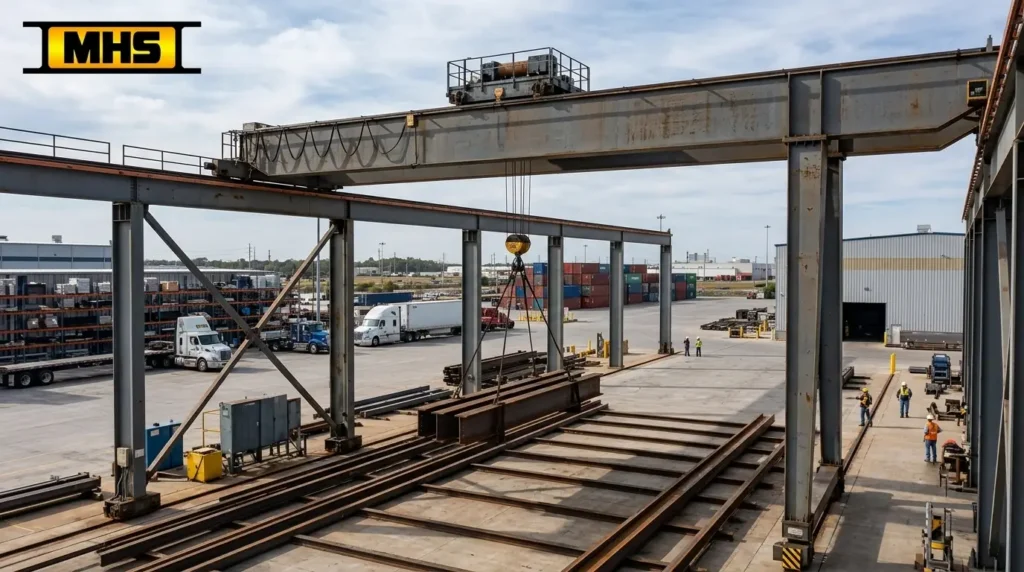
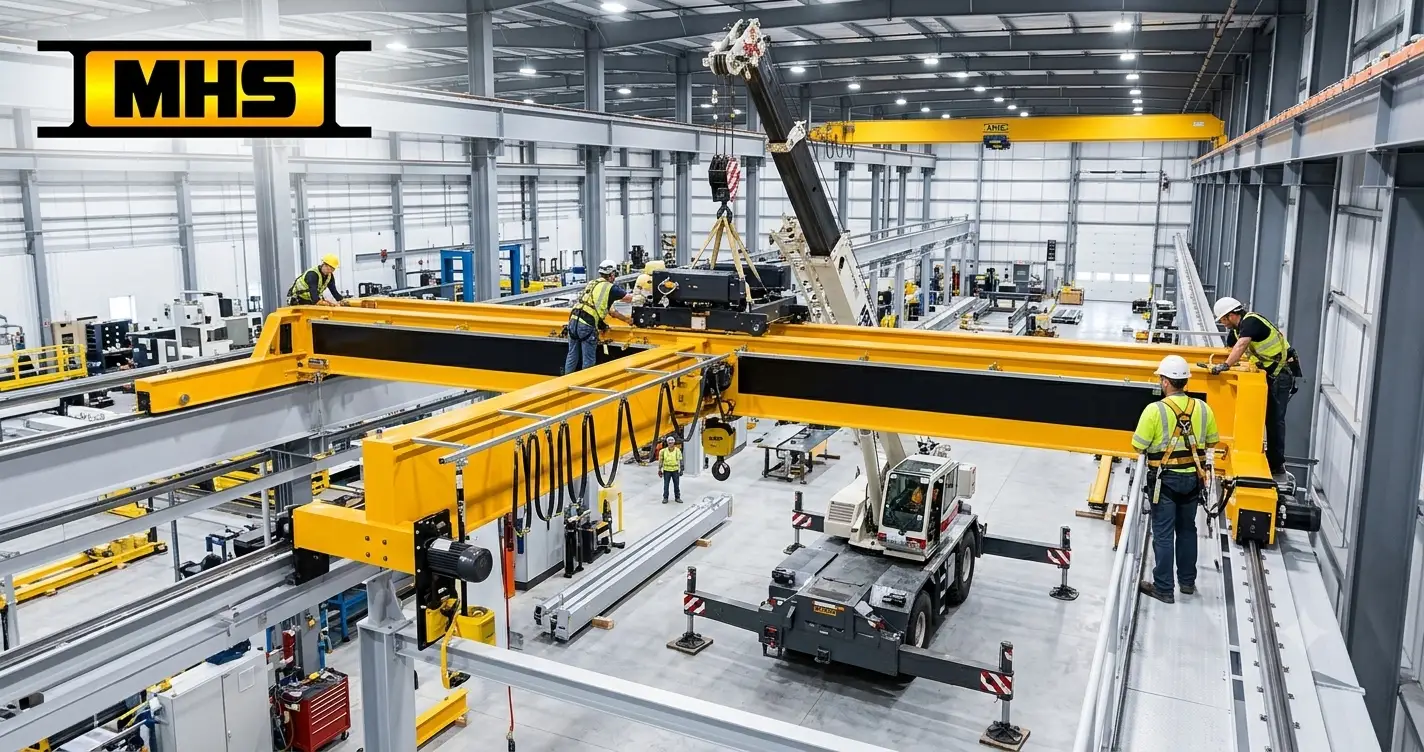
Overhead crane installation is the process of assembling, aligning, and securing a crane system — bridge, runway, hoist, and electrical components — to safely lift and move heavy loads in industrial facilities.
In Short :
- Installation covers structural, mechanical, and electrical assembly of a crane system
- The process runs through 8 core stages, from site inspection to load testing
- OSHA 1910.179 governs safety and commissioning requirements
- Timelines range from a few days to several weeks depending on crane size and facility readiness
Crane installation is not a single task — it’s a coordinated sequence of engineering review, structural work, mechanical assembly, and electrical integration. Facilities investing in a new material handling system need to understand each phase before committing to a timeline or budget.
Installation vs. assembly vs. commissioning are often used interchangeably, but they aren’t the same thing. Installation refers to the full physical setup of the crane system on-site. Assembly is a subset of installation — the mechanical joining of bridge, end trucks, hoist, and trolley components. Commissioning is the final phase, where the completed system is tested, calibrated, and certified for operation under load.
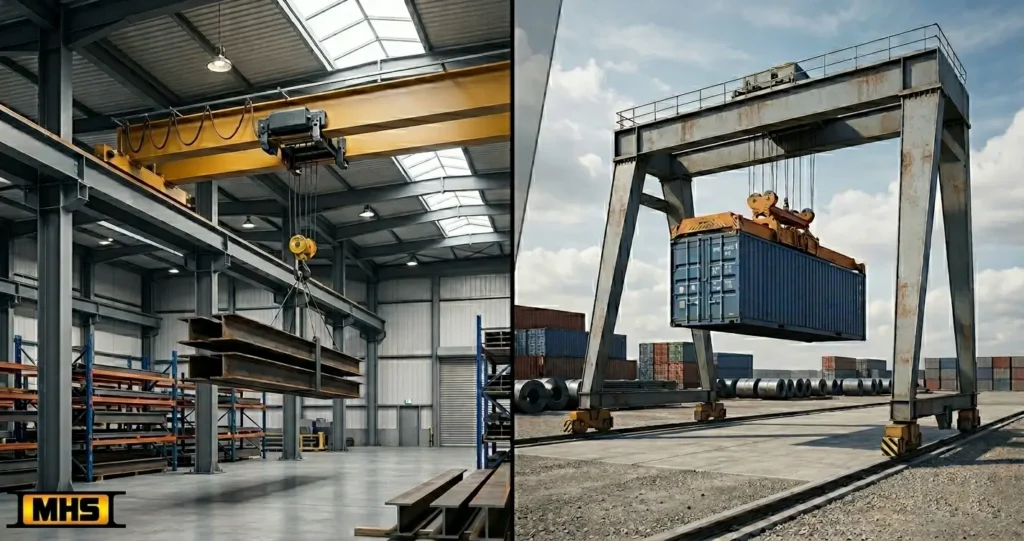
Types of Overhead Cranes and Installation Differences
Crane types determine installation complexity, structural requirements, and project timelines, with different overhead crane types requiring different installation methods.
| Crane Type | Structural Support | Typical Use Case | Installation Complexity |
| Top-running bridge crane | Runway beams on columns | Heavy manufacturing, foundries | High |
| Under-running bridge crane | Ceiling/roof structure | Warehouses, light assembly | Medium |
| Gantry crane | Floor-mounted legs, no building support needed | Outdoor yards, shipping | Medium-High |
| Monorail crane | Single fixed rail | Repetitive linear lifting paths | Low-Medium |
| Workstation crane | Freestanding or wall-mounted | Workbenches, small assembly cells | Low |
Bridge crane installation typically requires the building’s structure — or dedicated support columns — to carry both the crane’s dead weight and its rated load. This makes structural evaluation the first and most critical installation step.
Gantry cranes, by contrast, don’t rely on the building structure at all. Their legs sit on the floor or rails, which reduces engineering dependency on the facility but increases floor-loading and foundation considerations.
Monorail and workstation cranes are the simplest to install, since they typically serve lighter capacities and smaller spans, with less structural coordination required.
Overhead Crane Installation Process (Step-by-Step Breakdown)
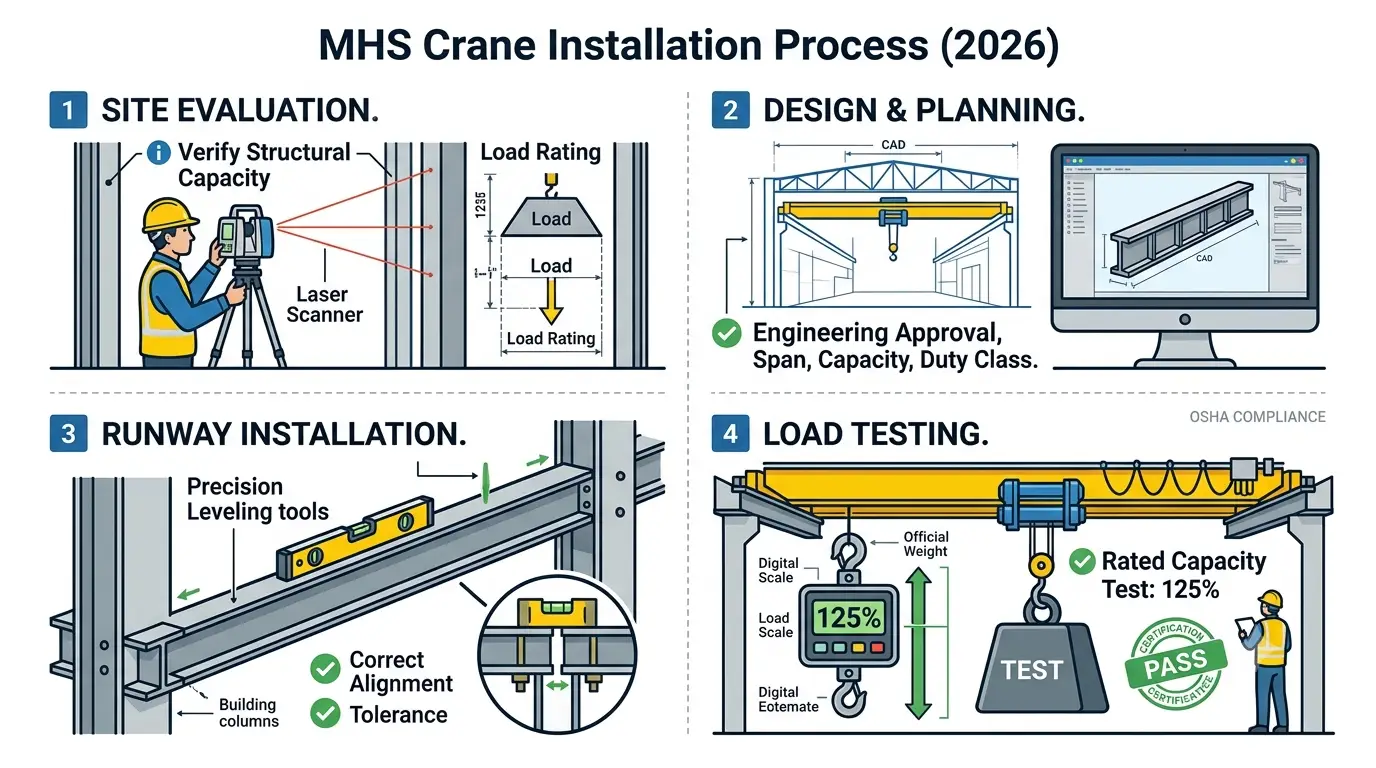
Overhead crane installation follows eight sequential stages — site inspection, design and engineering approval, delivery and staging, runway beam installation, bridge and end truck assembly, hoist and electrical installation, alignment and calibration, and final testing and commissioning.
Step 1 – Site Inspection and Structural Evaluation
Before any equipment arrives, engineers evaluate whether the building can support the crane’s dead weight, rated load, and dynamic forces during operation. This includes checking the building’s structural load capacity and confirming runway beam compatibility with the planned crane span and duty class. A facility that skips this step risks discovering, mid-installation, that reinforcement or new support columns are required.
Step 2 – Crane System Design and Planning
Span, capacity, and duty classification are finalized based on the site evaluation and the facility’s operational needs (how often the crane runs, average load weight, and shift intensity). Engineering drawings are then submitted for approval before fabrication begins — a step that protects against costly on-site design changes.
Step 3 – Delivery and Site Preparation
Components are staged in a designated area near the installation zone. This stage includes setting up safety barriers, defining clearance zones, and confirming that heavy equipment (mobile cranes, forklifts, and manlifts) has adequate site access.
Step 4 – Runway Beam Installation
Runway beams are set, leveled, and structurally anchored to the building or support columns. Alignment tolerances here are tight — beam misalignment at this stage compounds into bridge travel and wheel wear problems later.
Step 5 – Bridge and End Truck Assembly
This is where “assembling a crane” happens in the traditional sense: the bridge girder is connected to end trucks, and wheels and drive motors are installed to allow the bridge to travel along the runway.
Step 6 – Hoist and Electrical Installation
The hoist is mounted to the trolley, and the electrical system, including the power supply, conductor bar or festoon system, and control wiring, is installed and connected. This stage also includes wiring for pendant or radio remote controls.
Step 7 – Crane Alignment and Calibration
Technicians verify rail alignment and check load distribution across wheels and runway beams. Poor alignment at this stage is one of the leading causes of premature wheel and rail wear.
Step 8 – Testing and Commissioning
The crane undergoes no-load testing first, followed by rated load testing per OSHA requirements. Final safety validation, including limit switches, emergency stops, and braking systems, is confirmed before the crane is released for operational use.
How Are Cranes Assembled on Construction Sites?
On active construction sites, crane assembly often happens under tighter space and time constraints than in a finished facility. Mobile cranes are typically used to lift and position bridge girders and structural components before the permanent runway system is completed.
Field assembly introduces specific challenges: coordinating with other trades and subcontractors, managing site traffic around heavy lifts, and maintaining safety protocols in a dynamic, partially built environment. Because construction sites change daily, installation crews frequently re-verify clearances and access routes before each major lift, which is something less common in a completed facility installation.
Overhead Crane Installation Requirements (OSHA & Engineering Standards)
Overhead crane installation must comply with OSHA 1910.179 (overhead and gantry crane standards) and OSHA 1910.147 (lockout/tagout for hazardous energy control), alongside applicable structural and electrical codes.
Structural requirements include verified load ratings for runway beams and support columns, calculated based on the crane’s rated capacity plus dynamic and impact loads.
OSHA crane installation requirements cover rated load testing (typically 100-125% of rated capacity, depending on jurisdiction), functional testing of all safety devices, and documented inspection prior to operational release.
Electrical and mechanical compliance requires proper grounding, overload protection, and limit switch function, which is confirmed during commissioning, not assumed from manufacturer specs.
Crane Installation Safety Checklist
- Structural load capacity verified against crane weight and rated load
- Lockout/tagout procedures established for all energized components
- Fall protection in place for elevated installation work
- Rated load test completed and documented
- Emergency stop and limit switch function confirmed
- Third-party inspection scheduled where required by local code
Overhead Crane Installation Cost (What You Should Expect)
Overhead crane installation cost depends primarily on crane capacity, span, facility modifications required, and labor complexity — with most industrial installations ranging from a few thousand dollars for small workstation systems to well over $100,000 for large-capacity bridge crane systems requiring structural work.
Factors that most affect cost:
- Crane capacity and size — heavier rated loads require larger structural members and more robust mechanical components
- Facility modifications — adding support columns or reinforcing existing structure adds significant cost versus installing on an already-rated building
- Labor and engineering — engineering review, structural drawings, and skilled installation labor are a substantial share of total cost
- Electrical scope — new power supply runs and control system integration add cost beyond the mechanical installation itself
Facilities without existing structural support built to carry crane loads should budget for this as the largest variable cost — often exceeding the price of the crane equipment itself.
How Long Does Overhead Crane Installation Take?
Installation timelines scale with crane size and facility readiness, not just crane capacity alone.
| Crane Size/Type | Typical Installation Duration |
| Small workstation crane | 1–3 days |
| Standard single-girder bridge crane | 1–2 weeks |
| Large double-girder bridge crane | 3–6 weeks |
| Installation requiring new structural support | 6+ weeks |
Factors that delay installation include unplanned structural reinforcement, permitting delays, electrical infrastructure gaps, and site access constraints. Planning and engineering approval typically take longer than physical execution — facilities should budget more time for design review than for the on-site build itself.
Common Mistakes in Crane Installation (And How to Avoid Them)
- Improper runway alignment — leads to premature wheel wear and uneven load distribution; verified through precision leveling tools, not visual estimation
- Incorrect load calculations — underestimating dynamic and impact loads during structural design creates safety risk; always engineered to duty classification, not just static rated capacity
- Poor electrical setup — undersized conductor systems or improper grounding causes control failures; requires code-compliant electrical design from the start
- Safety violations during assembly — skipping lockout/tagout or fall protection during installation is a leading cause of installation-phase injuries
- Lack of post-installation testing — skipping full load testing risks discovering structural or mechanical issues during actual operation instead of before it
Who Installs Overhead Cranes?
Overhead cranes are typically installed by certified crane installation companies employing structural engineers, licensed electricians, and trained rigging and installation technicians, rather than general contractors or in-house maintenance teams without crane-specific certification.
Engineers handle structural and load calculations. Riggers and installation technicians manage physical assembly and alignment. Electricians handle power supply, control system, and wiring integration. Professional installation matters because misaligned structural work or improperly rated components create liability that surfaces only after the crane is in operation — often after a facility has already accepted delivery.
Crane Installation Safety Requirements and Best Practices
- Lockout/tagout procedures — required under OSHA 1910.147 for all hazardous energy sources during installation and maintenance
- Worker safety protocols — fall protection, PPE, and controlled access zones during structural and electrical work
- Load testing requirements — rated load testing per OSHA 1910.179 before operational release
- Emergency stop system checks — functional verification of all e-stops and limit switches prior to sign-off
Crane Installation Services
Professional overhead crane installation services typically include site evaluation, structural engineering review, bridge and runway installation, hoist and electrical integration, load testing, and post-installation maintenance support. Facilities evaluating installation providers should confirm certified technician credentials, documented load testing procedures, and post-installation support availability before selecting a contractor.
Final Thoughts
Overhead crane installation is a structured, multi-phase process — not a single mechanical task. Getting it right requires structural evaluation, engineering precision, OSHA-compliant safety practices, and rigorous load testing before a system is ever put into operation. Facilities planning a new installation should prioritize certified, experienced installation teams over cost alone, since structural or safety shortcuts during installation create liability that outlasts any savings on the front end.
FAQs
Q: How are overhead cranes installed step by step?
A: Installation follows eight stages — structural inspection, design approval, delivery and staging, runway beam installation, bridge assembly, hoist and electrical setup, alignment, and load testing. Each stage must be completed and verified before moving to the next. Skipping structural evaluation is the most common source of downstream delays.
Q: What is the cost of overhead crane installation?
A: Cost depends on crane capacity, span, and whether the facility needs structural modifications. Small workstation cranes may cost a few thousand dollars, while large bridge crane systems requiring new support structures can exceed $100,000. Facility modifications are often the largest cost variable, not the crane itself.
Q: How long does crane installation take?
A: Small workstation cranes install in 1–3 days, while large double-girder bridge cranes with new structural support can take six weeks or more. Engineering and permitting timelines often exceed the physical installation time. Facilities should plan for design review as the longest phase.
Q: Do overhead cranes require foundation work?
A: Not always — top-running bridge cranes rely on existing building structure, while gantry cranes require dedicated floor foundations to support their legs. Foundation needs depend on crane type and facility structural capacity. A structural evaluation determines this before installation begins.
Q: Is OSHA approval required for crane installation?
A: OSHA doesn’t “approve” installations directly, but installations must comply with OSHA 1910.179 for load testing and safety devices, and 1910.147 for lockout/tagout during the work itself. Non-compliant installations create both safety and liability risk. Third-party inspection is often required by local code even where OSHA doesn’t mandate it directly.
Q: Bridge crane vs. gantry crane, which is easier to install?
A: Gantry cranes are generally faster to install since they don’t require building structural modifications, relying instead on floor-mounted legs. Bridge cranes require more upfront structural engineering but often suit permanent, high-frequency lifting environments better. The right choice depends on facility structure and lifting frequency, not installation speed alone.