
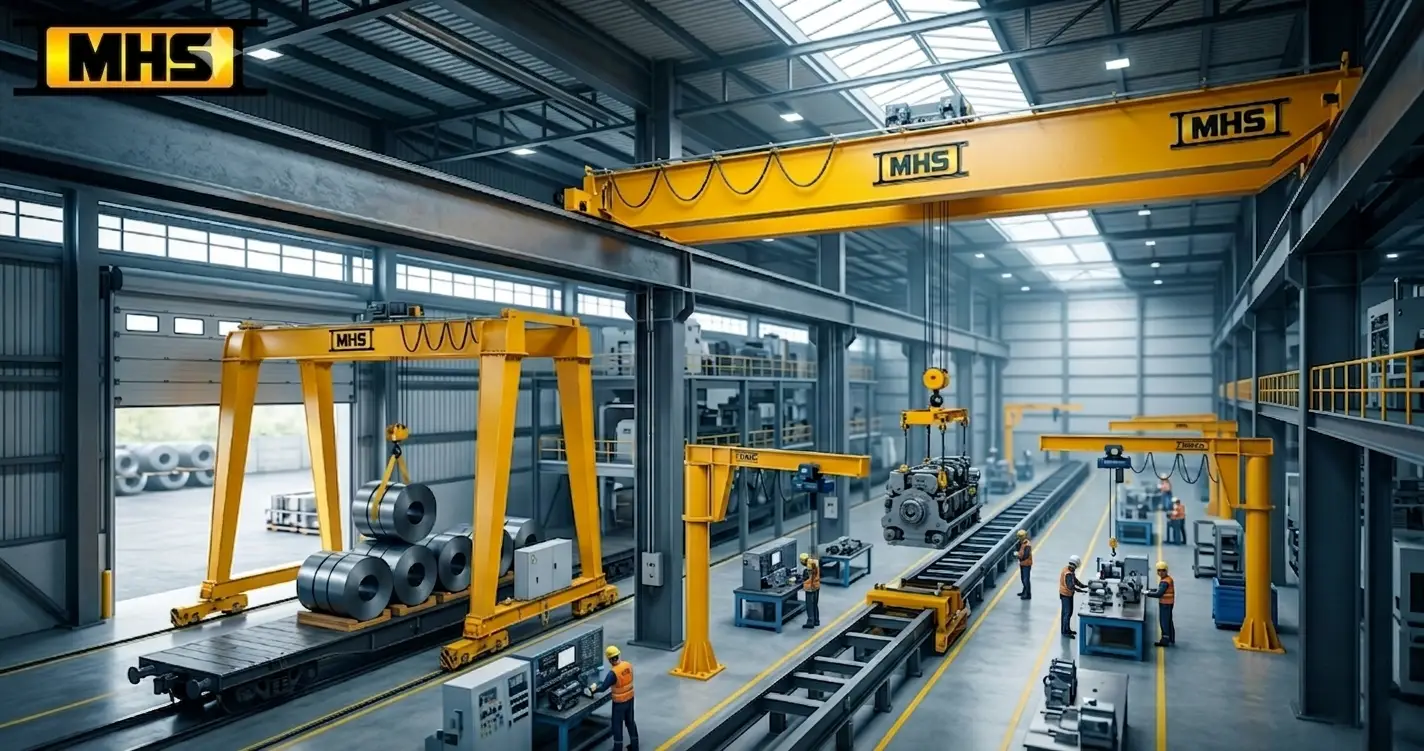
Overhead cranes are material handling systems used in factories, warehouses, and industrial facilities to lift and move heavy loads efficiently. The main types of overhead cranes include bridge cranes, gantry cranes, monorail cranes, jib cranes, and workstation cranes. Each type is designed for different lifting capacities, space conditions, and industrial applications.
What Is an Overhead Crane?
An overhead crane is a lifting machine that moves along elevated runways installed at the top of a facility. It carries loads horizontally and vertically without taking up floor space, making it one of the most efficient industrial lifting systems available today.
Overhead travelling crane systems typically run on crane runway systems, parallel beams or rails mounted to the building structure or freestanding supports. The crane bridge travels along these runways while the hoist moves along the bridge, giving full coverage of the work area below.
These machines play a central role in material handling cranes used across modern industry. Whether it is a warehouse overhead crane handling pallets or factory cranes moving heavy steel components, overhead systems keep operations moving efficiently.
Common applications include:
- Factory cranes used in assembly and fabrication
- Manufacturing cranes supporting production lines
- Warehouse overhead crane setups for storage and dispatch
Without reliable overhead crane applications, many industrial processes would slow significantly or require far more manual labor.
Main Types of Overhead Cranes
Bridge Cranes (Most Common Type)
Bridge cranes are the most widely used type of industrial overhead crane in the world. They consist of one or two horizontal beams called a crane bridge that span the width of a facility. The bridge travels along a crane runway system mounted on rails at the top of the building.
Bridge crane systems give full coverage of a rectangular work area. The hoist travels along the bridge, allowing operators to pick up and place loads anywhere within the crane’s range.
These systems handle everything from light assembly work to the heaviest industrial lifting equipment operations. They are the standard choice in steel mills, automotive plants, and large manufacturing facilities.
Single Girder vs Double Girder Bridge Cranes
| Feature | Single Girder | Double Girder |
| Load Capacity | Light to medium | Heavy duty overhead crane |
| Cost | Lower | Higher |
| Hook Height | More hook height | Less hook height |
| Best For | Small workshops | Large factories |
A single girder overhead crane uses one main beam and is ideal for lighter loads and tighter budgets. It offers better hook height because the hoist hangs below the beam.
A double girder overhead crane uses two parallel beams and supports far heavier loads. It allows the hoist to sit on top of the beams, which is better for very heavy duty operations but reduces available hook height.
Top Running vs Under Running Cranes
| Feature | Top Running | Under Running |
| Installation | Rides on top of runway beams | Hangs below runway beams |
| Capacity | Higher | Lower |
| Maintenance | Easier access | More limited access |
| Space Needed | Requires more headroom | Works in lower ceilings |
A top running crane rides on rails mounted on top of the runway beams. It supports heavier loads and is easier to maintain.
An under running crane — sometimes called an underhung crane — travels along the bottom flange of the crane runway beams. It works well in buildings with low ceilings and is a smart choice when space is limited. The trade-off is lower capacity and slightly more restricted maintenance access.
Gantry Cranes
Overhead gantry cranes work like bridge cranes, but instead of being supported by a building’s walls or columns, they stand on their own legs. These legs roll along floor-level rails or travel on wheels, making them a fully freestanding crane system.
This design is ideal when a building’s structure cannot support a ceiling-mounted system or when cranes need to operate outdoors. Gantry cranes are common in shipyards, precast concrete yards, and large warehouses.
There are two main variants:
- Full gantry cranes — both legs travel on floor rails, giving maximum independence from the building structure
- Semi-gantry cranes — one leg runs on a floor rail while the other end rides on a wall-mounted runway, saving floor space
Gantry cranes come in both heavy industrial versions and smaller indoor crane configurations for workshops and light manufacturing.
Monorail Cranes
A monorail crane moves along a single fixed rail or track, usually an I-beam monorail crane system installed in the ceiling. The hoist travels in one straight line or along a pre-set curved path, making it a perfect fit for repetitive lifting tasks.
Monorail cranes are widely used in production line cranes and assembly line cranes where loads always move along the same route. They integrate cleanly into overhead lifting systems and keep floor space completely clear.
Because monorail cranes have a fixed path, they are not designed for flexible movement. Their strength is speed and consistency in high-volume operations.
Jib Cranes
A jib crane has a horizontal arm, the jib, that rotates around a central mast or wall mount. The hoist travels along this arm, giving the operator a circular or semi-circular work zone.
Jib cranes are a popular small overhead crane solution for individual workstations. They are fast to operate, easy to control, and take up very little space. A jib crane is often the first choice when someone needs an overhead crane for a shop or a single production cell.
There are two main types:
- Wall-mounted jib cranes — attached directly to a wall or building column, ideal for corner or perimeter stations
- Freestanding jib cranes — anchored to the floor and can be placed anywhere in a facility
Jib cranes typically handle lighter loads and are rarely used for heavy-duty operations, but they excel at boosting speed and reducing strain at individual workstations.
Workstation Cranes
Workstation cranes are lightweight, ergonomic overhead crane systems designed for repetitive lifting at dedicated work areas. They typically use light aluminum or steel tracks and are easy to install, reconfigure, and expand.
These systems are ideal for production areas where workers perform the same lifting task dozens of times per day. A good workstation lifting solution reduces physical strain, lowers the risk of injury, and speeds up cycle times.
Workstation cranes can be ceiling-mounted or freestanding. They are commonly used in packaging lines, light assembly, and quality inspection areas.
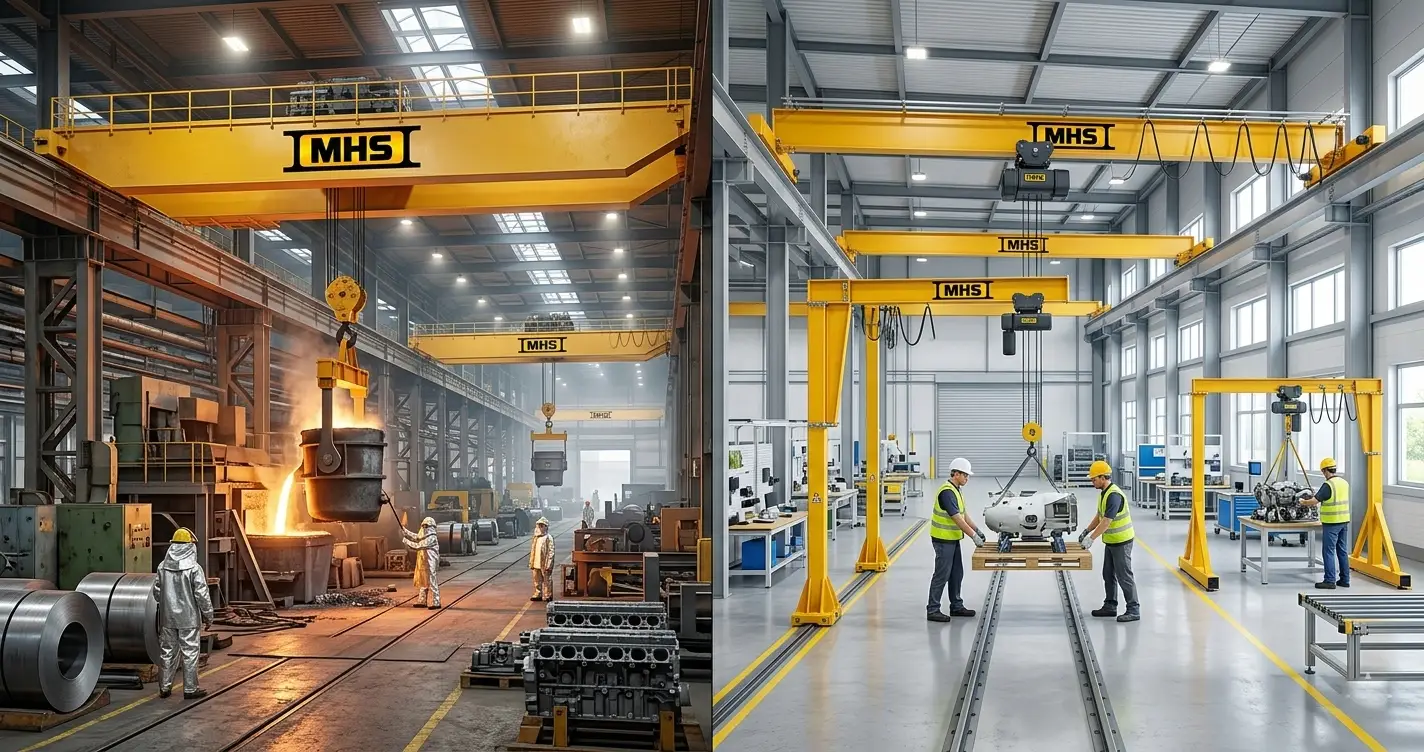
Process Cranes vs Modular Cranes
Process Cranes
Process cranes are built for continuous, heavy-duty industrial operations. They run around the clock in demanding environments like steel mills, foundries, and automotive manufacturing plants. These cranes are engineered for precision, durability, and reliability under constant use.
They are custom-designed to match specific production requirements and are not easily moved or reconfigured. Durability and uptime are the top priorities.
Modular Cranes
Modular cranes take a flexible approach to industrial crane systems. They are built from standardized components that can be assembled, expanded, or reconfigured as a facility’s needs change.
A business can start with a small system and scale it up without replacing the entire crane. This makes modular systems a cost-effective option for growing operations.
The choice between process cranes vs modular cranes usually comes down to how stable and permanent the operation is. Heavy, fixed production environments favor process cranes. Flexible or growing facilities benefit more from modular designs.
Comparison of Overhead Crane System Types
| Crane Type | Best Use | Load Capacity | Industry |
| Bridge Crane | General lifting | Medium to Heavy | Manufacturing |
| Gantry Crane | Outdoor and large loads | Heavy | Warehousing |
| Monorail Crane | Fixed path lifting | Light to Medium | Assembly lines |
| Jib Crane | Local workstation lifting | Light | Workshops |
| Workstation Crane | Repetitive tasks | Light | Production areas |
How to Choose the Right Overhead Crane System
Selecting the right crane comes down to matching the system to the job. Here is a simple decision framework:
Load weight requirements — Light loads suit monorail, jib, or workstation cranes. Medium loads work well with single girder bridge cranes. A heavy-duty overhead crane with a double girder bridge is best for the heaviest industrial work.
Facility type — A manufacturing plant usually needs a full bridge crane system. A warehouse overhead crane setup may call for a gantry or monorail. A workshop often does best with a jib or small workstation crane.
Space availability — Low ceilings favor under running cranes or workstation systems. Buildings without structural crane support need freestanding gantry or jib cranes. An indoor crane must fit within the existing building dimensions.
Usage frequency — Occasional lifts can be handled by simpler systems. Continuous operations need process-grade industrial overhead crane equipment built for high cycle counts.
Material flow — If loads always travel the same path, a monorail is efficient. If loads move freely across a work area, bridge crane systems give full coverage.
These factors together guide overhead crane applications across all industries. Matching the crane type to the actual workflow improves safety, reduces cost, and extends equipment life.
Industries That Use Overhead Cranes
Overhead cranes appear in almost every sector that handles heavy or bulk materials:
- Manufacturing plants — factory cranes support fabrication, assembly, and machining operations
- Steel fabrication units — heavy-duty cranes move raw stock and finished sections throughout production
- Automotive industry — manufacturing cranes handle engines, body panels, and large assemblies
- Warehouses and logistics centers — warehouse overhead crane systems speed up receiving, storage, and dispatch
- Construction material handling — cranes move precast elements, steel beams, and large panels on site
- Shipping yards — industrial crane systems load and unload vessels and move containers efficiently
Material handling cranes in these industries reduce manual labor, cut cycle times, and keep operations safer. Without reliable industrial crane systems, most of these facilities would struggle to meet production targets.
Benefits of Modern Overhead Lifting Systems
Modern overhead lifting systems deliver clear, measurable advantages over manual or ground-level handling:
Improved safety — Lifting loads overhead removes them from the floor, reducing collision risks and keeping walkways clear.
Faster material movement — An industrial overhead crane moves loads across large distances in seconds, far faster than forklifts or manual carts.
Reduced labor dependency — One operator can handle loads that would otherwise require several workers.
Increased productivity — Cranes run continuously and rarely need breaks, which keeps production lines moving.
Lower downtime — Modern systems are built for reliability, and modular designs make maintenance and repairs straightforward.
Investing in the right overhead lifting systems pays off quickly in throughput, safety records, and overall operational efficiency.
Conclusion
Understanding the types of overhead cranes helps any facility make a smarter investment in lifting equipment. Bridge cranes cover the widest range of applications. Gantry cranes solve the challenge of outdoor or unsupported spaces. Monorail cranes bring efficiency to fixed production paths. Jib and workstation cranes handle light, repetitive tasks with speed and precision.
No single system works best everywhere. The right choice depends on load weight, facility layout, usage frequency, and the nature of the work being done. Matching the overhead crane types to the actual job leads to better safety, lower costs, and higher output.
For any facility planning to install or upgrade an industrial overhead crane, consulting with a qualified crane systems specialist is always the right first step. A professional assessment ensures the bridge crane systems, runway layout, and lifting capacity are correctly matched to your operation from day one.
Frequently Asked Questions
What are the different types of overhead cranes?
The main types are bridge cranes, gantry cranes, monorail cranes, jib cranes, and workstation cranes. Each is suited to different load weights, facility layouts, and industrial tasks.
What is the difference between bridge cranes and gantry cranes?
Bridge cranes are supported by a building’s runway structure and run along wall-mounted rails. Gantry cranes are freestanding and travel on floor-level rails or wheels, making them suitable for outdoor use or buildings without structural support.
Which overhead crane is best for small workshops?
A jib crane or workstation crane is usually the best fit for small workshops. They are compact, affordable, and easy to install without major structural changes.
What is the difference between top running and under running cranes?
A top running crane rides on top of the runway beams and supports heavier loads. An under running crane hangs below the runway beams and works better in low-clearance buildings with lighter load requirements.
What industries use industrial overhead cranes?
Steel fabrication, automotive manufacturing, warehousing, construction, shipping, and general manufacturing all rely heavily on industrial overhead cranes for daily operations.
What is the strongest type of overhead crane?
Double girder bridge cranes are generally the strongest type of overhead crane. They are engineered for the heaviest industrial loads and are standard equipment in steel mills and heavy manufacturing plants.