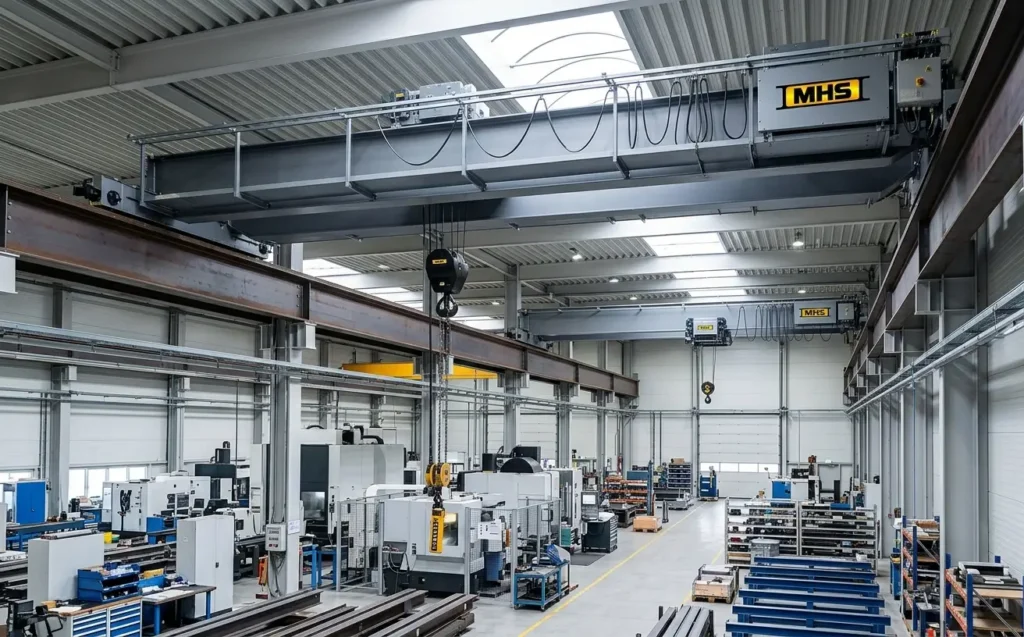
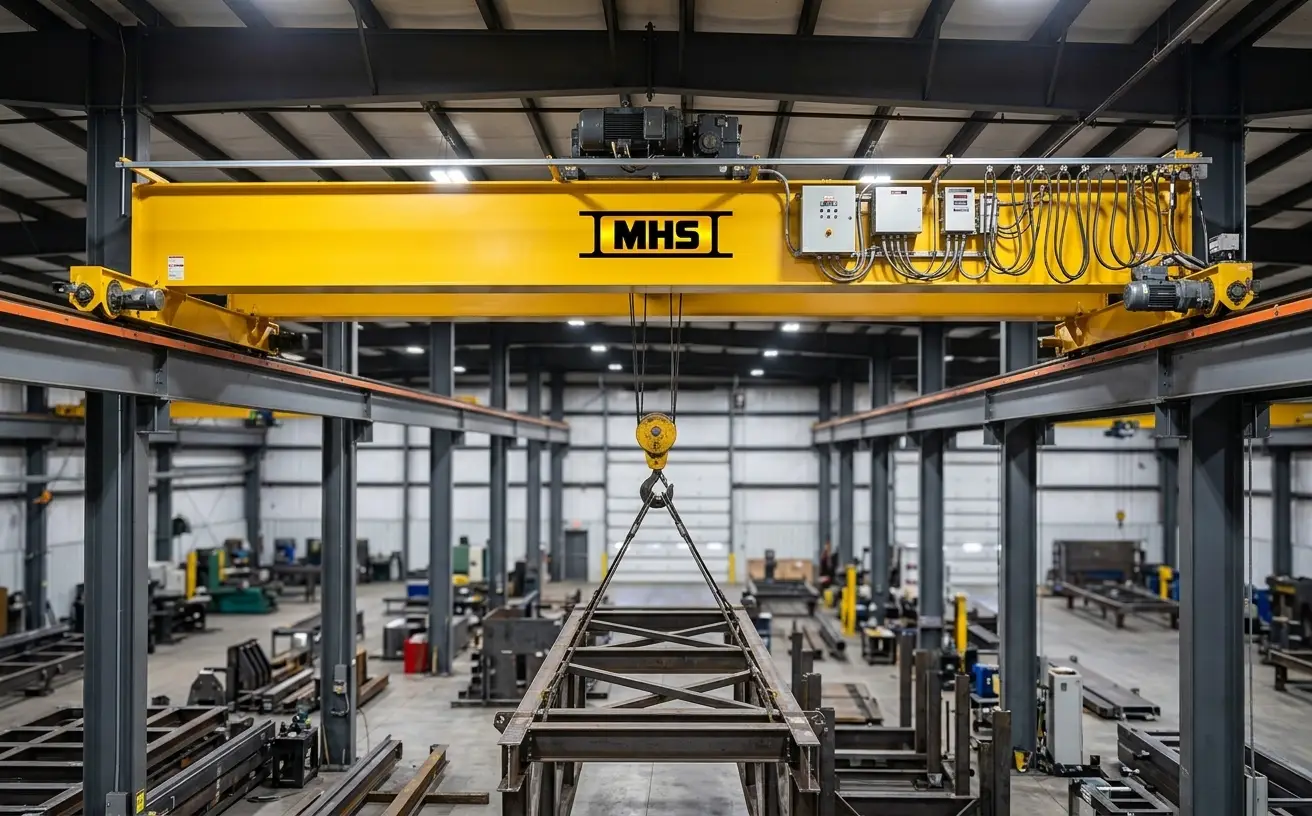
Overhead crane components fall into four categories: structural (bridge, girders, runway), mechanical (trolley, hoist, hook, wheels), electrical (motors, controls, wiring), and safety (limit switches, brakes, safety devices). Understanding each part matters because a crane’s reliability and safety depend on every component functioning correctly together, not just the hoist or the hook in isolation.
Quick Summary
- Overhead cranes are built from structural, mechanical, electrical, and safety components
- Each part has a distinct function, but they operate as one connected system
- Regular inspection of key components prevents most crane failures
- Replacement parts must match the crane’s original specifications and duty class
Facilities researching overhead crane components are usually doing one of three things: learning how a crane system works, diagnosing a problem, or sourcing replacement parts. This guide covers all three: what each component does, how they work together, and when a part needs repair versus replacement.
What Are the Main Components of an Overhead Crane?
The main components of an overhead crane are the bridge and girders, end trucks, trolley, hoist, hook, runway and runway rails, motors, brakes, controls, electrical components, and safety devices.
| Component | Category | Core Function |
| Bridge/Girders | Structural | Spans the crane bay, supports trolley and hoist |
| End Trucks | Structural/Mechanical | Support the bridge, carry it along the runway |
| Runway/Runway Rails | Structural | Fixed track the crane travels on |
| Trolley | Mechanical | Moves the hoist horizontally across the bridge |
| Hoist | Mechanical | Lifts and lowers the load |
| Hook | Mechanical/Load-handling | Connects the crane to the load |
| Motors and Gearboxes | Mechanical/Electrical | Power bridge, trolley, and hoist movement |
| Brakes | Mechanical | Stop and hold lifting or travel motion |
| Controls | Electrical | Let the operator direct all crane movement |
| Electrical Components | Electrical | Power distribution, wiring, VFDs |
| Safety Devices | Safety | Limit switches, overload protection, bumpers |
This is the extractable answer — the section-by-section breakdown below covers what each of these crane components actually does and why it matters.
Overhead Crane Components and Their Functions
Bridge and Bridge Girders
The bridge is the horizontal structure spanning the width of the crane bay, and the girders are the main structural members that make it up. In a single girder crane, one bridge girder carries the load; in a double girder crane, two girders share the structural load, which allows for higher capacity and longer spans.
The bridge girder supports both the trolley and hoist, so its structural integrity directly determines the crane’s safe load capacity. Girder deflection under load is engineered within strict tolerances – excessive deflection is one of the first signs a crane is being operated beyond its rated capacity.
End Trucks
End trucks sit at each end of the bridge and support it while allowing the entire crane to travel along the runway. They house the wheels, and in most designs, the drive motor and gearing that move the bridge along the runway rails.
Because end trucks carry the full weight of the bridge, trolley, hoist, and load, wheel condition and end truck alignment are frequent points of wear that affect smooth crane travel.
Trolley
The trolley rides along the bridge and moves the hoist horizontally, perpendicular to bridge travel. Together, bridge movement and trolley movement give the crane its full range of horizontal positioning across the crane bay.
Trolley design varies by crane type — under-running (underhung) trolleys hang below the girder in single girder systems, while top-running trolleys ride on top of the girders in double girder systems.
Hoist
The hoist is the component responsible for vertical lifting and lowering. Electric hoists are most common in industrial settings, though pneumatic and manual hoists serve specific applications where electrical power isn’t practical or where finer manual control is needed.
Wire rope hoists use a drum and cable system for lifting, while chain hoists use a chain and sprocket mechanism — the right choice depends on load capacity, lift height, and duty cycle.
Hook
The hook is the direct connection point between the crane and the load, making it one of the most safety-critical crane parts on the entire system. Hooks are typically forged steel, rated to match the crane’s load capacity, and fitted with a safety latch to prevent accidental load disengagement.
Because the hook takes the full force of every lift, routine hook inspection for cracks, deformation, or throat opening beyond tolerance is a standard part of any crane safety program.
Runway and Runway Rails
The runway is the fixed track system — mounted on building support structures or dedicated support columns — that the crane’s end trucks travel along. Runway rails must be properly aligned and level; misalignment causes uneven wheel loading, premature wheel wear, and rough bridge travel.
Runway condition is often overlooked in crane maintenance programs, even though poor rail alignment can shorten the lifespan of end trucks and wheels significantly.
Motors and Gearboxes
Motors provide the power for bridge travel, trolley movement, and hoisting. Gearboxes transfer that motor power into controlled mechanical movement, stepping down motor speed to the slower, more controlled motion needed for precise load positioning.
Gear motors are typically rated for specific duty cycles — a motor sized for occasional light lifts will wear out quickly if used for continuous, high-cycle industrial applications.
Brakes
Crane brakes stop and hold lifting or travel movement, and they’re one of the most safety-critical mechanical systems on the crane. Hoist brakes must hold a suspended load safely even in the event of a power loss — this is a fundamental design requirement, not an optional feature.
Brake maintenance and inspection are non-negotiable parts of any crane safety program, since brake failure during a lift creates immediate risk to personnel and equipment.
Controls and Pendant Controls
Operators direct crane movement — lifting, lowering, trolley travel, and bridge travel — through pendant controls, remote controls, or in larger installations, an operator cab with a full control panel. Radio remote control is increasingly common, letting operators control the crane from a safer vantage point away from the load path.
The crane control system also typically includes variable frequency drives (VFDs), which allow smoother acceleration and deceleration than older fixed-speed control setups — reducing load swing and mechanical stress on the crane.
Electrical Components
Overhead crane electrical components include the electrical panel, wiring, disconnects, conductor bars or festoon systems (for power delivery to a moving bridge and trolley), and VFDs. These systems deliver power to every motor-driven component on the crane and route control signals from the operator to the crane’s movement systems.
Electrical faults are a common source of crane downtime, which is why electrical inspection is typically included as its own category in a proper crane maintenance program.
Limit Switches and Safety Devices
Overhead crane safety components include limit switches, which stop hoist, trolley, or bridge movement automatically when travel reaches a preset boundary — preventing over-hoisting, over-travel, or collision. Additional safety devices include overload protection, bumpers at the ends of bridge and trolley travel, and audible/visual warning systems.
These components exist specifically to prevent operator error or mechanical failure from becoming a safety incident, which is why they’re checked separately from general mechanical wear during inspections.
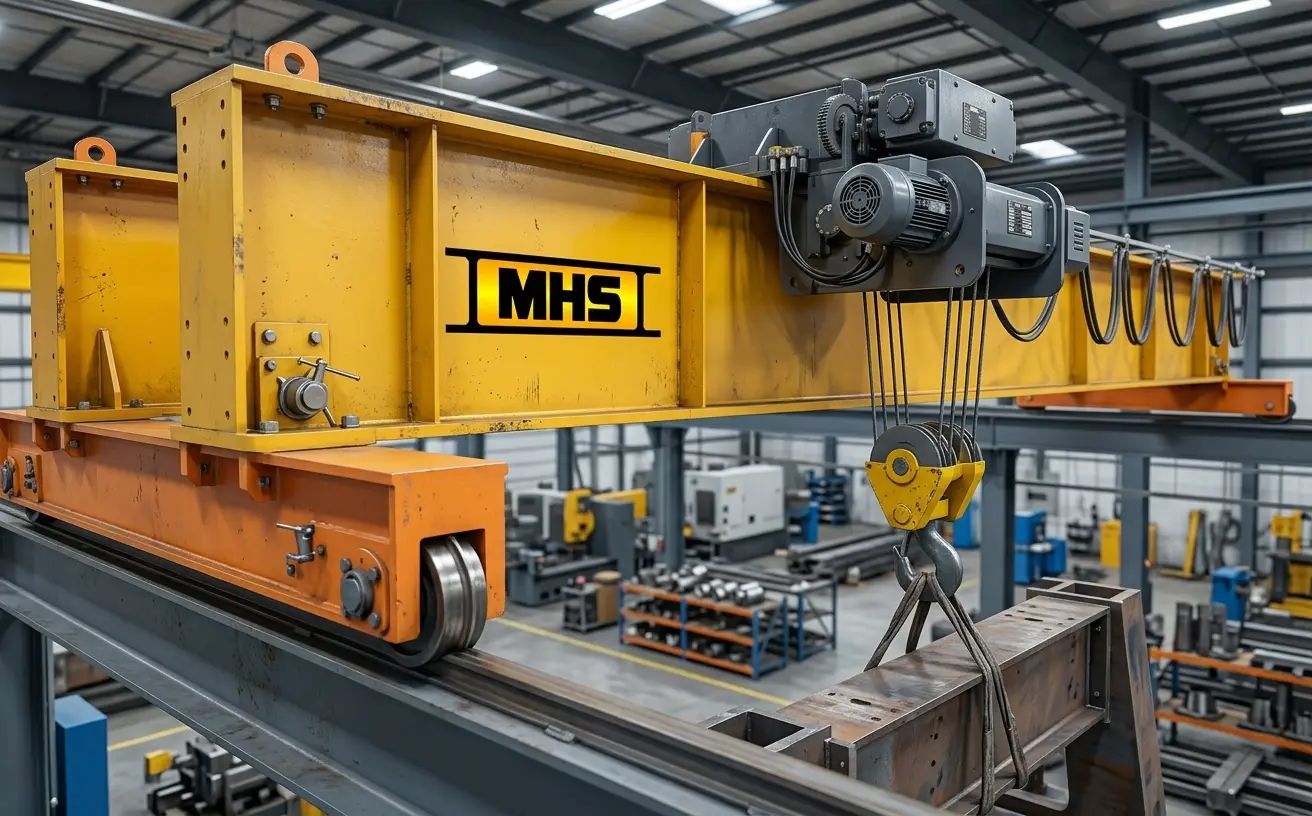
Overhead Crane Diagram: Understanding the Main Parts
A labeled overhead crane diagram is the fastest way to see how the bridge, end trucks, trolley, hoist, hook, runway, and control system relate to each other physically. Below is a breakdown of what each numbered section of a typical overhead bridge crane components diagram identifies:
- Runway rails — fixed track mounted to the building structure
- End trucks — support the bridge and ride along the runway
- Bridge girder(s) — spans the crane bay, single or double girder
- Trolley — travels along the bridge, carries the hoist
- Hoist — mounted to the trolley, handles vertical lifting
- Hook and hook block — connects to the load
- Control panel/pendant — operator interface for all movement
- Conductor bars or festoon system — delivers electrical power to the moving bridge and trolley
This diagram-based view answers overhead bridge crane parts and crane bridge parts queries at a glance — a labeled visual asset communicates these spatial relationships far more clearly than text description alone.
Mechanical vs. Electrical Overhead Crane Components
Overhead crane components are split into mechanical components (which handle physical movement and load-bearing) and electrical components (which power and control that movement).
Mechanical Components
- Bridge and girders
- End trucks
- Trolley
- Hoist
- Hook
- Wheels
- Gears
- Brakes
Electrical Components
- Motors
- Controls (pendant, remote, control panel)
- Wiring
- VFDs
- Limit switches
- Electrical panels
This distinction matters practically: mechanical failures usually show up as physical symptoms (noise, vibration, misalignment), while electrical failures show up as control or power issues (unresponsive controls, erratic movement, power loss). Diagnosing which category a problem falls into is often the first step in any crane repair.
Overhead Crane Hoist Parts
A crane hoist is made up of a hoist motor, gearbox, drum, wire rope or chain, hook, hook block, brake, and limit switch, all working together to lift and lower loads safely.
| Hoist Part | Function |
| Hoist motor | Powers the lifting and lowering motion |
| Gearbox | Converts motor power into controlled lifting speed |
| Drum | Wire rope hoists wind cable around a drum during lifting |
| Wire rope or chain | Physically bears the load during lifting |
| Hook | Connects the hoist to the load |
| Hook block | Houses the hook and sheaves (pulleys) that guide the wire rope |
| Brake | Holds the load in place and prevents uncontrolled descent |
| Limit switch | Stops hoisting at the upper and lower travel limits |
Wire rope hoists and chain hoists both handle vertical lifting, but they differ in capacity range and application — wire rope hoists generally suit heavier loads and longer lift heights, while chain hoists are common in lighter-duty and lower-headroom applications.
Overhead Crane Replacement Parts
Overhead crane components typically need replacement — rather than repair — when wear, damage, or failure compromises safe load-bearing capacity or reliable operation.
Common replacement parts include:
- Wheels
- Hooks
- Wire rope
- Chains
- Brakes
- Motors
- Limit switches
- Controls
- Electrical components
A critical consideration: replacement parts must be properly matched to the crane’s original specifications, capacity rating, and duty class. Installing a generic or mismatched part — even one that appears physically compatible — can compromise load rating, void manufacturer warranties, and create a serious safety hazard. Sourcing replacement parts through a qualified crane specialist, rather than a generic industrial supplier, is the safer path when the part in question affects load-bearing capacity.
How Do Overhead Crane Components Work Together?
A complete lift follows one connected sequence: operator controls → motor → hoist, trolley, and bridge movement → hook → load.
Here’s how that sequence plays out in practice:
- The operator issues a command through a pendant, remote, or control panel.
- That signal reaches the appropriate motor — hoist motor for vertical movement, trolley motor for horizontal movement across the bridge, or bridge motor for travel along the runway.
- The gearbox converts motor power into controlled mechanical movement.
- The hoist raises or lowers the hook via wire rope or chain.
- The hook engages the load, and the trolley and bridge reposition it as needed.
- Limit switches and brakes govern the boundaries and stopping points of every movement
No single component performs a lift on its own — the bridge, trolley, hoist, runway, and control system function as one integrated crane system. A failure or misalignment in any single part (a worn wheel, a faulty limit switch, an underperforming brake) affects the reliability and safety of the entire lifting operation, not just that one component.
What Are the Most Important Overhead Crane Components for Safety?
No single component is universally “most important,” but the hook, wire rope or chain, brakes, limit switches, controls, structural components, and runway carry the highest safety weight because failure in any of them creates direct risk during a lift.
- Hook — the sole connection point to the load; cracks or deformation risk load drop
- Wire rope/chain — bears the full load weight; fraying or damage is a direct failure risk
- Brakes — must hold a suspended load reliably, including during power loss
- Limit switches — prevent over-travel, over-hoisting, and collisions
- Controls — operator’s only interface for stopping or redirecting crane movement
- Structural components (bridge, girders, end trucks) — govern overall load-bearing capacity
- Runway — misalignment here compounds into wheel, end truck, and bridge travel issues
Routine inspection and maintenance of these specific components is the most effective way to prevent the majority of overhead crane safety incidents.
When Should Overhead Crane Components Be Repaired or Replaced?
Overhead crane components should be inspected and addressed immediately when they show excessive wear, unusual noise, cracks or deformation, damaged wire rope or chain, brake problems, electrical issues, uneven crane travel, excessive vibration, or outright component failure.
Common warning signs by category:
- Mechanical: excessive wear on wheels or gears, unusual noise during operation, uneven bridge or trolley travel, excessive vibration
- Structural: cracks or visible deformation in the bridge, girders, or end trucks
- Load-bearing: frayed, kinked, or damaged wire rope or chain
- Braking: slipping, delayed engagement, or failure to hold a suspended load
- Electrical: intermittent control response, wiring damage, or repeated fault codes
A general rule for the repair-versus-replace decision: components affecting load-bearing capacity (hooks, wire rope, structural members) should be replaced rather than repaired whenever damage is present, since a repaired load-bearing part carries higher risk than a new one. Non-structural components like controls or minor electrical parts have more room for repair, provided the fix restores full original function.
Overhead Crane Maintenance and Inspection Basics
A proper crane maintenance program includes daily, monthly, and annual inspection cycles, each covering different components at different depths.
| Inspection Frequency | Focus Areas |
| Daily | Visual check of hook, wire rope, controls, and obvious damage |
| Monthly | Brakes, limit switches, wheels, and electrical connections |
| Annual | Full structural inspection, load testing where required, comprehensive component review |
Regular inspections following recognized standards (OSHA, ASME, CMAA) catch component wear before it becomes a failure. Preventive maintenance — lubrication, bearing checks, brake adjustment — extends crane lifespan and reduces the frequency of unplanned crane breakdowns, which is almost always more expensive than scheduled service.
Get Expert Help With Overhead Crane Components
Understanding your crane’s components is the first step — keeping them properly maintained, repaired, and replaced is what keeps lifting operations safe and reliable over the long term. MHS Crane provides expert support across the full range of overhead crane components, including repairs, inspections, hoist service, modernization, replacement parts, and custom engineering and manufacturing.
Contact us for expert help with overhead crane components, repairs, replacements, and service.
Frequently Asked Questions
Q: What are the main components of an overhead crane?
A: The main components are the bridge and girders, end trucks, trolley, hoist, hook, runway, motors, brakes, controls, electrical components, and safety devices. Each handles a distinct function, but they operate together as one lifting system. Structural components support the load; mechanical and electrical components move it.
Q: What are the parts of an overhead bridge crane?
A: An overhead bridge crane includes the bridge girders, end trucks, runway and runway rails, trolley, hoist, hook, and a control system. The bridge and end trucks form the structural base, while the trolley and hoist handle load movement. Controls direct all bridge, trolley, and hoist movement.
Q: What is the most important component of an overhead crane?
A: There isn’t one universally “most important” component, since safe operation depends on the entire system working together. That said, the hook, hoist, brakes, controls, and structural components carry the highest safety weight, since failure in any of them creates direct risk during a lift.
Q: What are the main parts of a crane hoist?
A: A crane hoist includes a hoist motor, gearbox, drum, wire rope or chain, hook, hook block, brake, and limit switch. The motor and gearbox power the lift, while the wire rope or chain and hook handle the load directly. The brake and limit switch govern safe stopping and travel limits.
Q: How often should overhead crane components be inspected?
A: Overhead cranes typically need daily visual checks, monthly mechanical and electrical inspections, and a full annual structural inspection. Frequency can increase for high-duty-cycle or heavy industrial applications. For a full inspection schedule and checklist, see our dedicated crane inspection guide.
Q: Do single girder and double girder cranes use different components?
A: The core component categories are the same, but configuration differs — single girder cranes use an under-running trolley beneath one girder, while double girder cranes use a top-running trolley across two girders. Double girder systems also often include additional structural and safety components suited to higher capacity.
Q: Can overhead crane replacement parts be used across different crane brands?
A: Not reliably — replacement parts should be matched to the crane’s original specifications, capacity rating, and duty class, not just physical fit. Using a generic or mismatched part can compromise load rating and safety. A qualified crane specialist can confirm correct part matching for load-bearing components specifically.