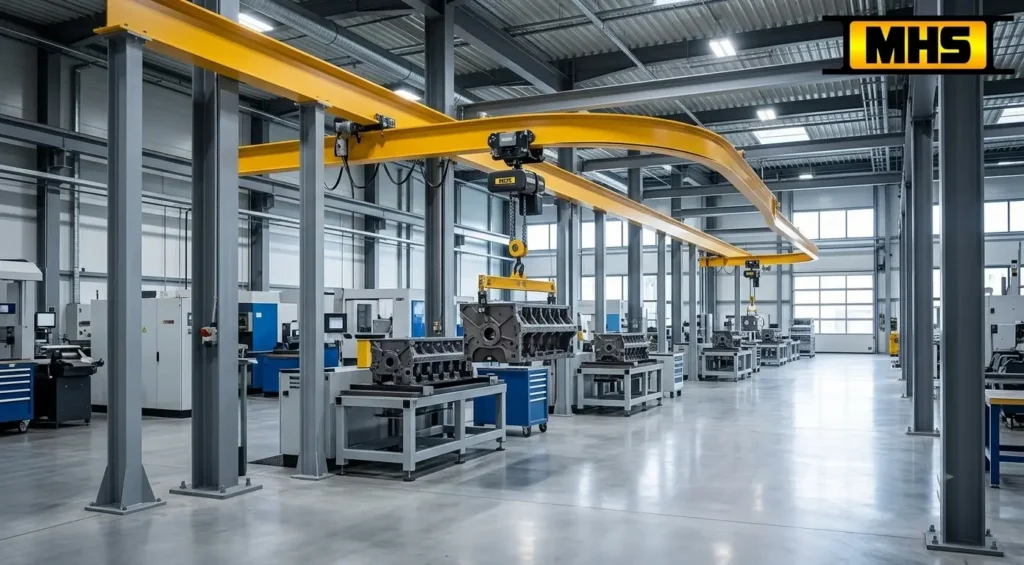
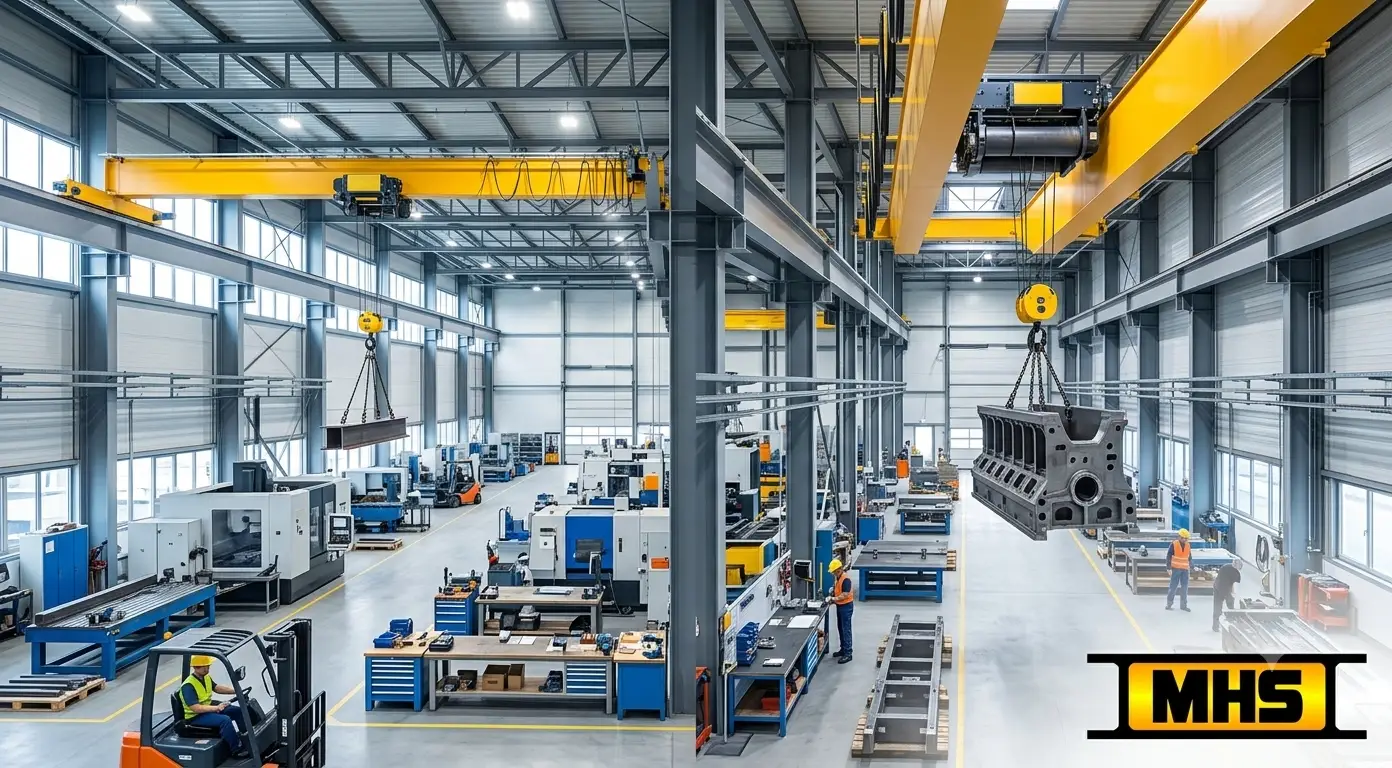
A single girder crane uses one main bridge girder and suits lighter loads, shorter spans, and simpler facility layouts. A double girder crane uses two parallel girders and handles heavier loads, longer spans, and higher-duty industrial use. The right choice depends on your crane lifting capacity needs, span, headroom, and how often the crane runs.
Quick Summary
- Single girder cranes fit light to medium-duty loads and moderate spans
- Double girder cranes handle heavy loads, long spans, and higher hook heights
- Girder count alone doesn’t set capacity — the engineered system does
- Cost, headroom, and duty cycle all factor into the right decision
Facilities researching single girder vs double girder crane options usually land here after outgrowing manual material handling or after a structural engineer flags a span or capacity limit. Both are overhead bridge crane systems – often called EOT bridge cranes (electric overhead travelling cranes) – but they’re built for different jobs.
What Is a Single Girder Crane?
A single girder crane uses one bridge girder spanning between two end trucks, with a hoist trolley riding on the bottom flange of that single beam.
The girder itself is typically a wide flange beam or a fabricated box beam, supported at each end by end-trucks that ride along the runway rails. The hoist trolley , carrying an under-running or under-hung hoist, travels along the bottom of the girder rather than on top of it.
This under-running design is what keeps single girder systems compact. Because the hoist hangs below the beam instead of riding on top, the whole system needs less vertical clearance for a given hook height.
Typical single girder bridge crane applications include light to medium-duty material handling: moving parts between workstations, loading and unloading in a warehouse, or general lifting in a fabrication shop. Businesses choose a single girder overhead crane mainly for two reasons : lower capital cost and simpler installation, since there’s less steel, fewer components, and a lighter overall structure to support.
What Is a Double Girder Crane?
A double girder crane uses two parallel bridge girders, with the hoist trolley riding on top of the girders rather than underneath.
The two-girder design distributes load across both beams, which increases structural stability and allows for a top-running hoist configuration. This top-running crane setup can carry significantly more weight than an under-running system of comparable span, since the load path runs through two structural members instead of one.
Double girder bridge crane applications center on heavier and more demanding work: steel mills, foundries, and iron and steel production facilities where loads regularly exceed what a single girder system can safely or efficiently handle. The design also accommodates auxiliary hoists , a second, smaller hoist for lighter or more precise lifts alongside the main hoist, which single girder systems typically can’t support.
Double girder systems are common wherever overhead lifting needs to handle both heavy tonnage and frequent, high-cycle operation without excessive wear.
Single Girder vs Double Girder Crane: Key Differences
| Feature | Single Girder Crane | Double Girder Crane |
| Crane design | Single main girder | Two main girders |
| Hoist configuration | Under-running (below girder) | Top-running (above girders) |
| Load capacity | Typically lighter-duty | Typically higher-capacity |
| Span | Suitable for moderate spans | Better for longer spans |
| Headroom | Often requires less space | May require additional clearance |
| Cost | Generally lower initial cost | Generally higher initial cost |
| Applications | General material handling | Heavy-duty industrial lifting |
| Maintenance | Simpler configuration | More components (catwalk, dual hoist, split gearcase) |
| Facility requirements | Often easier to integrate | May require more structural planning |
Single Girder vs Double Girder: Which Has More Lifting Capacity?
Double girder cranes generally support higher lifting capacity than single girder cranes, but the correct capacity for any facility depends on the engineered system, not girder count alone.
Crane lifting capacity is driven by several factors working together: girder depth, steel consumption, deflection limits, and how the load distributes across the runway system. A single girder crane engineered with a deep box girder can outperform an undersized double girder system, which is why capacity should always come from a load calculation, not an assumption based on design type.
That said, as required capacity climbs into higher tonnage ranges, double girder construction becomes the more practical and cost-effective path. Two girders sharing the load allows for a stiffer structure without the excessive girder depth a single-girder design would need to match that same capacity.
Duty cycle matters here too. A crane running frequent, high-cycle lifts near its rated capacity experiences far more structural fatigue than one making occasional light lifts, which is where CMAA duty classification comes in. Cranes are rated from A2 (standby/infrequent use) through A8 (severe duty, continuous high-cycle operation). Facilities running near-constant lifting cycles, steel mills, foundries, high-volume fabrication, typically need double girder systems built to A6–A8 classifications, while general warehouse or maintenance use often fits comfortably within A2–A4.
How Does Crane Span Affect Your Choice?
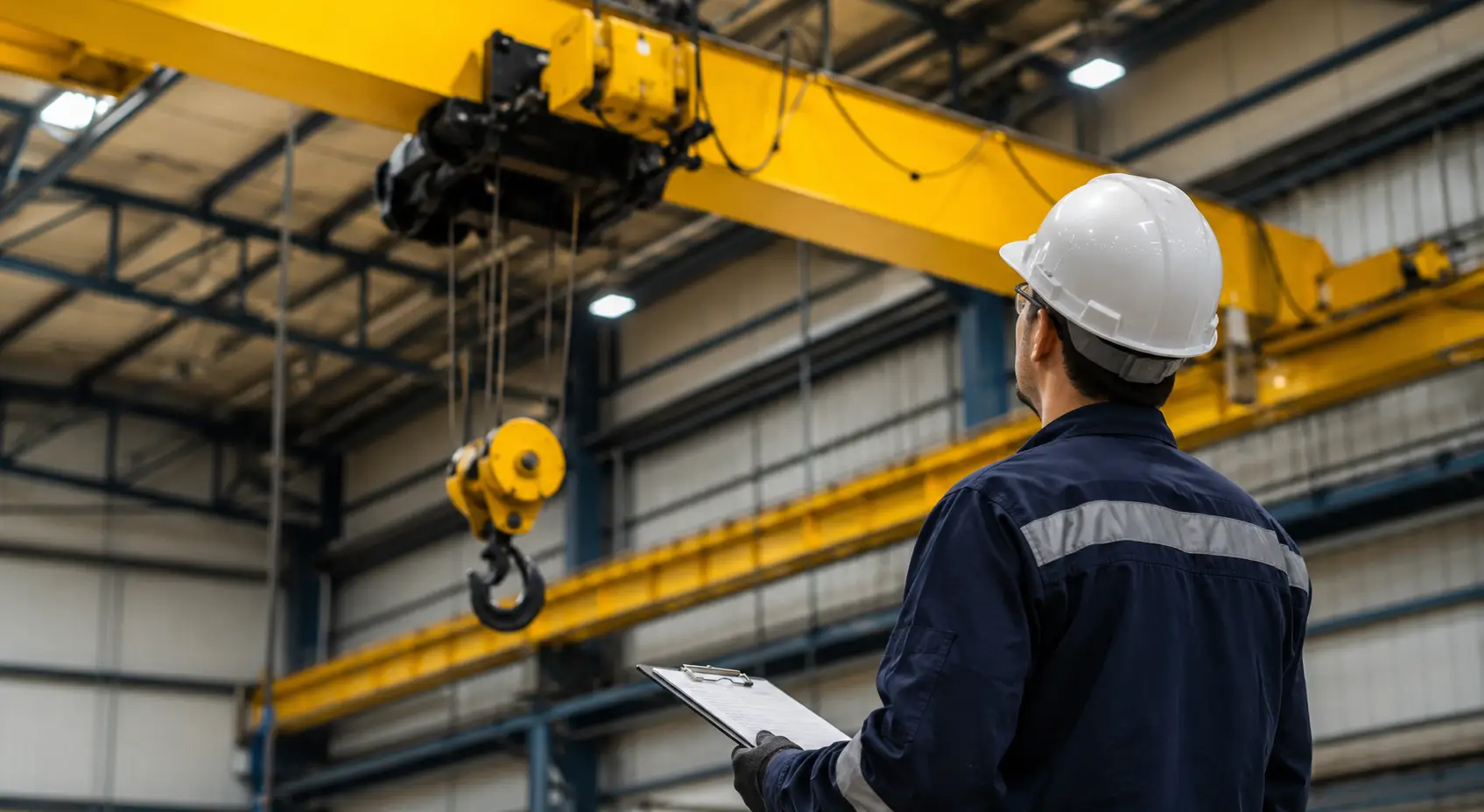
Crane span, the distance between runway rails, has practical limits for single girder systems; beyond a certain point, double girder construction becomes structurally more efficient.
As span increases, a single beam has to resist more bending and deflection across its length. Single girder cranes typically stay efficient up to moderate spans. Push much beyond that, and the girder depth required to control deflection starts adding disproportionate weight and cost, at which point a double girder design, which shares that structural load across two girders, becomes the more economical engineering solution.
Building dimensions and existing runway configuration play a direct role here. If your facility’s runway beams and support columns were built for a specific span, that measurement, not preference, often decides which crane type fits. A short-span workshop or fabrication bay is a natural fit for single girder. A wide production floor or heavy material yard with long, uninterrupted spans tends to favor double girder construction.
Which Crane Requires More Headroom?
Double girder cranes generally require more headroom than single girder cranes because the top-running hoist and trolley sit above the girders rather than below them.
Hook height, the usable lifting height from the floor to the maximum hook travel, depends on how much vertical space the crane structure itself consumes above the hook. In a single girder, under-running system, the hoist rides below the girder, so less overall vertical clearance is lost to the crane structure. In a double girder, top-running system, the trolley sits on top of the girders, adding the girder depth plus the trolley height to the total headroom consumed.
This is one of the most common constraints facilities run into: an older building with limited roof clearance, HVAC ductwork, sprinkler lines, or other overhead obstructions may not have enough vertical clearance for a double girder system to deliver the hook height the application actually needs. Evaluating existing building clearance, including sprinkler clearance and any code-driven separation requirements, is a required step before committing to either design, not an afterthought.
Single Girder vs Double Girder Crane Cost
Single girder cranes generally cost less upfront than double girder cranes, but the lowest purchase price isn’t always the lowest total cost over the crane’s service life.
Initial equipment cost favors single girder systems, less structural steel, a simpler hoist configuration, and fewer components like catwalks, service platforms, or dual-hoist setups.
Installation and structural costs shift the comparison. A double girder crane installed in a building with adequate existing runway structure and headroom may cost less to install than a single girder crane forced into a facility needing significant structural reinforcement to meet span or capacity requirements.
Total cost of ownership should also weigh:
- Maintenance access and complexity (double girder systems often include catwalks and service walkways, adding maintenance cost but improving safety and access)
- Crane lifespan and durability under the actual duty cycle
- Operational efficiency — a crane matched correctly to duty cycle and capacity wears less and needs fewer unplanned repairs than one running consistently near its limits
The economical choice is the one engineered correctly for the application, not simply the one with the lower sticker price. Getting a proper crane quote based on an application analysis, rather than comparing base equipment cost alone, is the only reliable way to compare true crane cost between the two options.
What Applications Are Best for Each Crane Type?
Common Single Girder Crane Applications
- General manufacturing and light production
- Warehouses and distribution centers
- Fabrication shops
- General material handling equipment needs
- Maintenance operations and workshop crane use
Common Double Girder Crane Applications
- Heavy manufacturing and production facilities
- Steel handling, steel mills, and foundries
- Large machinery movement
- Heavy industrial facilities, including mining and iron/steel production
- High-capacity material handling in railyards, shipping ports, and material yards
Across both categories, these systems function as core industrial crane systems within a facility’s broader material handling solutions. The deciding factor is almost always whether the application calls for light to medium-duty lifting or genuinely heavy duty cranes built for sustained industrial output.
Facility Type and Operating Environment Considerations
Facility size, building age, and operating environment often narrow the choice before capacity or span calculations even come into play.
Smaller facilities and shops with limited floor space and moderate lifting needs typically default toward single girder systems, since the lighter structure integrates more easily into an existing building without major reinforcement. Large industrial plants, particularly those with heavy equipment lifting needs, high-cycle production, or specialized applications like die flipping, usually require the added stability and capacity double girder construction provides.
Outdoor and harsh-environment applications, material yards, ports, and transportation-adjacent facilities, add another layer of consideration. These environments often demand more robust building support structure and foundation planning regardless of girder type, since wind loading, corrosion exposure, and continuous outdoor duty cycles all affect long-term crane durability and performance.
Indoor facilities with controlled environments, like assembly facilities and production floors, generally have more flexibility to choose based on capacity and span alone, without the added structural planning outdoor installations require.
How to Choose Between a Single and Double Girder Crane
A practical decision framework:
- Determine required crane lifting capacity based on actual load weight, not estimates
- Measure the required crane span using existing or planned runway structure
- Evaluate available headroom, including any HVAC, sprinkler, or structural obstructions
- Consider duty cycle and lifting frequency — map your operation against CMAA duty classifications
- Review facility structure, including building support structure and foundation capacity
- Identify application requirements — general handling versus heavy industrial or specialized lifting
- Compare installation and long-term costs, not just base equipment price
- Work with qualified crane engineers to confirm capacity, span, and structural fit before ordering
Skipping the structural review is the single most common mistake facilities make — assuming an existing building can support a crane type without confirming runway loads, wheel loads, and support column capacity first.
Can a Single Girder Crane Be Upgraded or Modernized?
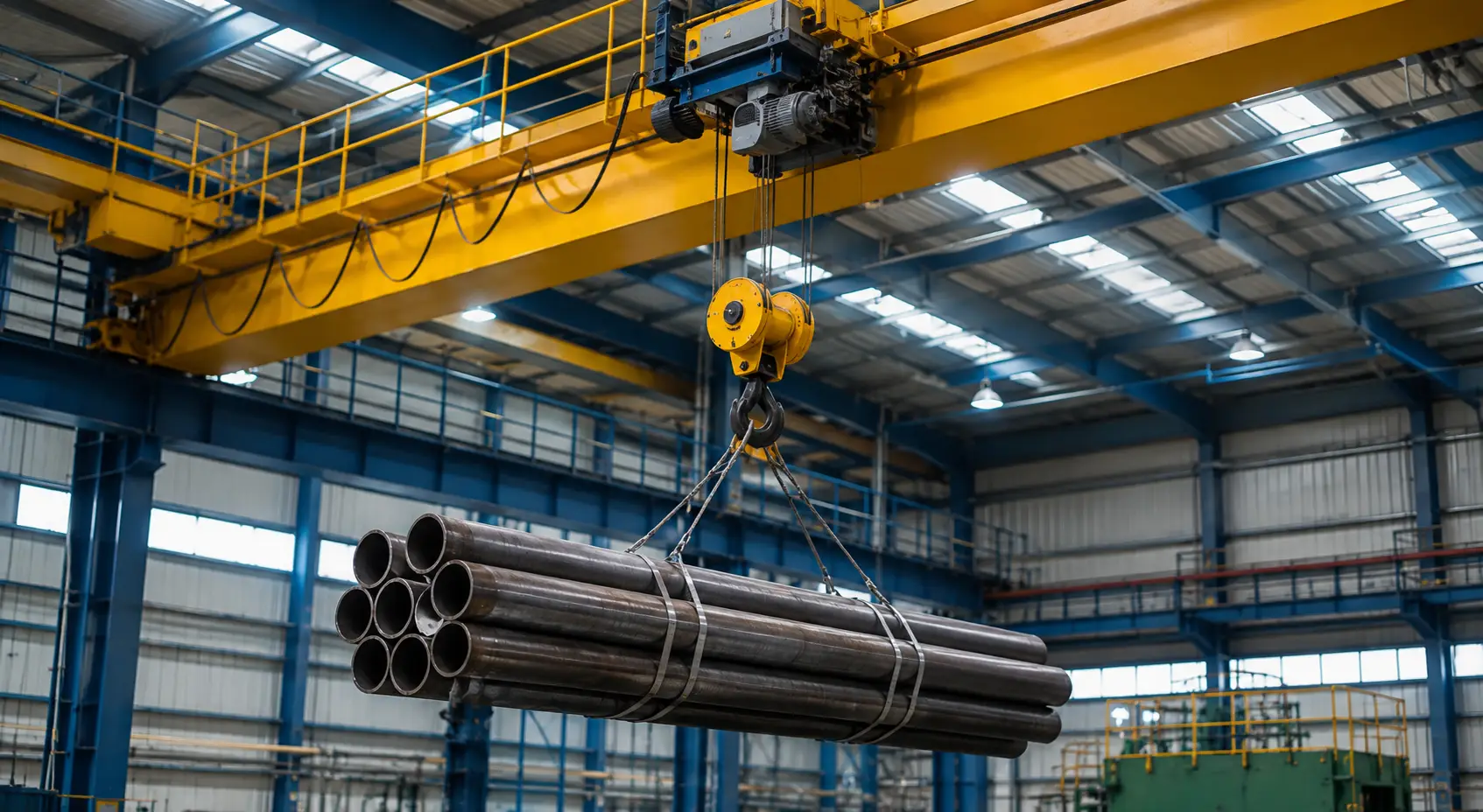
Yes, many single girder cranes can be modernized with upgraded controls, hoists, and electrical systems, but capacity and span limits are structural and usually can’t be solved through modernization alone.
Crane modernization commonly includes:
- Upgrading control panels and adding variable frequency drives
- Replacing older hoists with more efficient or higher-capacity units within the girder’s rated limits
- Updating electrical systems, wiring, and safety interlocks
- Adding features like magnetic cable reels or improved lighting
Modernization makes sense when the underlying structure, girder, runway, and support columns, still has capacity to spare, and the goal is improving efficiency, reliability, or control precision rather than increasing rated load.
Where modernization stops working: if a facility’s lifting needs have outgrown the single girder’s structural capacity or span limits, no amount of control or hoist upgrading solves that. At that point, the application requires a full system redesign, often a shift to double girder construction, rather than an upgrade path.
Common Mistakes When Choosing Between Single and Double Girder Cranes
- Sizing capacity to current needs only – without accounting for future production growth, facilities often undersize and outgrow the system within a few years
- Ignoring duty cycle – selecting based on peak load alone while ignoring how frequently the crane will actually cycle leads to premature wear
- Skipping the headroom evaluation – discovering a hook height shortfall after a double girder system is already ordered is a costly, avoidable error
- Comparing base equipment cost only – without factoring installation, structural reinforcement, and maintenance access into total cost
- Assuming the existing runway system can support a heavier crane – without an engineering review of runway loads and support column capacity
Installation and Maintenance Considerations
Both single and double girder cranes require professional installation and a routine maintenance schedule to operate safely and reliably over their service life.
Professional crane installation includes structural verification, precise runway rail alignment, and load testing before the system enters service, steps that directly affect long-term crane performance and safety.
Ongoing crane maintenance should include:
- Routine crane inspection covering wheels, brakes, hoist components, and structural connections
- Preventive maintenance on gearcases, motors, and electrical systems
- Maintenance access review – double girder systems with catwalks or service platforms need that access kept clear and safe for technicians
This kind of overhead lifting equipment and industrial lifting equipment represents a long-term capital investment. Skipping preventive maintenance is one of the most common ways facilities shorten crane lifespan and end up facing unplanned downtime instead of scheduled service.
Single Girder vs Double Girder Crane: Final Verdict
A single girder crane is generally best for lighter or moderate-duty material handling applications where cost, simplicity, and available headroom are priorities. A double girder crane is typically better for heavier loads, longer spans, higher hook heights, and demanding industrial applications.
Final selection should always come down to your facility’s actual load requirements, span, duty cycle, and available headroom, confirmed through an engineered specification rather than a general rule of thumb.
Get Expert Help Choosing the Right Crane
Choosing between a single girder crane and a double girder crane comes down to engineering, not guesswork. MHS Crane provides application analysis, crane engineering, and custom specification for single girder cranes, double girder cranes, and everything in between, along with professional installation, inspection, maintenance, and modernization support.
Contact MHS Crane today to request an evaluation or quote tailored to your facility’s capacity, span, and operating requirements.
FAQs
Q: What is the difference between a single girder and double girder crane?
A: A single girder crane uses one bridge girder with an under-running hoist, while a double girder crane uses two girders with a top-running hoist. Double girder systems generally handle heavier loads and longer spans. The right choice depends on capacity, span, and headroom at your facility.
Q: Is a single girder crane cheaper than a double girder crane?
A: Single girder cranes typically cost less upfront due to less structural steel and simpler components. Installation costs can shift this comparison depending on existing building structure. Total cost of ownership should factor in maintenance and duty cycle, not just purchase price.
Q: Which is better for heavy loads, single or double girder?
A: Double girder cranes are generally better suited for heavy loads because two girders share the structural load more efficiently. Single girder cranes can be engineered for higher capacity using a deeper box girder, but this becomes less cost-effective at higher tonnage. Actual capacity always depends on the engineered system.
Q: Which crane has a longer span?
A: Double girder cranes are generally better suited for longer spans since sharing the load across two girders reduces deflection issues. Single girder cranes work well for moderate spans in smaller facilities. Span limits should be confirmed through an engineering review of the specific application.
Q: Does a double girder crane require more headroom?
A: Yes, typically. The top-running hoist configuration sits above the girders, consuming more vertical clearance than a single girder’s under-running hoist. Facilities with limited roof clearance or overhead obstructions should evaluate headroom carefully before selecting a double girder system. This is often a deciding factor independent of capacity needs.
Q: How do I choose the right overhead crane for my facility?
A: Start by confirming required lifting capacity, span, and available headroom, then factor in duty cycle and application type. Review your building’s structural capacity before finalizing a choice. Working with a qualified crane engineer ensures the system matches your actual operating conditions, not just estimated needs.
Q: Can a single girder crane be converted into a double girder system?
A: Generally, no — girder configuration is a structural design choice made during engineering, not a field conversion. If capacity or span needs exceed a single girder’s limits, a new double girder system is typically required rather than a retrofit. A crane engineer can confirm whether any partial structural reuse is possible.
Q: What duty classification should I choose for frequent, heavy-cycle lifting?
A: Frequent, high-cycle heavy lifting typically requires a CMAA A6 through A8 duty classification, commonly paired with double girder construction. Lighter, less frequent use often fits within A2 to A4 classifications. Duty class should be based on actual lift frequency and load, not just maximum capacity.