The main difference between top running and under running cranes is how the bridge travels relative to the runway beams. A top running crane operates on top of the runway rails, while an under running (underhung) crane travels beneath the runway, using the lower flange of the beam. The right choice depends on building structure, available headroom, required lifting capacity, and the specific application.
Quick Summary
- Top running cranes ride above the runway and generally support heavier loads
- Underhung cranes ride below the runway and often suit tighter headroom
- Building structure and existing conditions frequently decide the choice before capacity does
- Neither configuration is universally better. The fit depends on the facility
Facilities comparing top running vs under running cranes are usually facing one of two situations: designing a new crane system from scratch, or trying to fit a crane into a building that already has structural or space constraints. Both configurations are common overhead crane systems, but they solve different problems.
What Is a Top Running Crane?
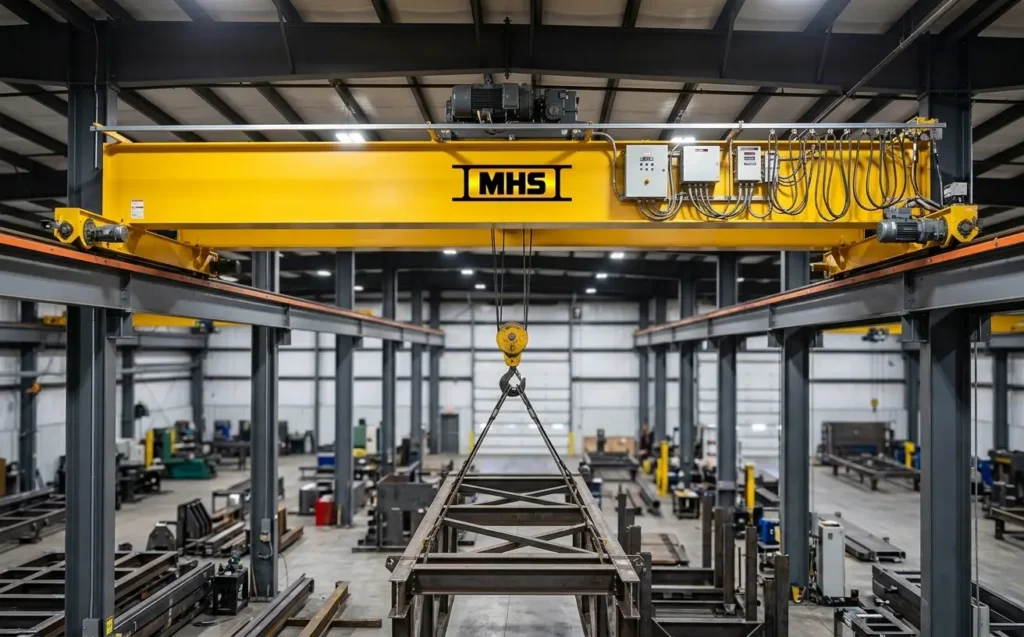
A top running crane is an overhead crane where the bridge and end trucks travel on top of the runway rails, with the full weight of the crane and load transferred down through the runway beams to dedicated support columns.
In this configuration, the crane bridge sits above the runway system, and crane wheels on the end trucks ride directly on top of the rail. This top-mounted arrangement gives the structure a wider, more stable load path, which is a major reason top-running overhead crane systems are the standard choice for heavy industrial lifting.
Typical applications include steel mills, foundries, casting plants, and heavy manufacturing facilities where high capacity, long spans, and continuous or heavy-duty cycles are the norm. Facilities with the structural capacity to support dedicated runway support columns and adequate roof or ceiling clearance are natural candidates for a top running design.
What Is an Underhung Crane?
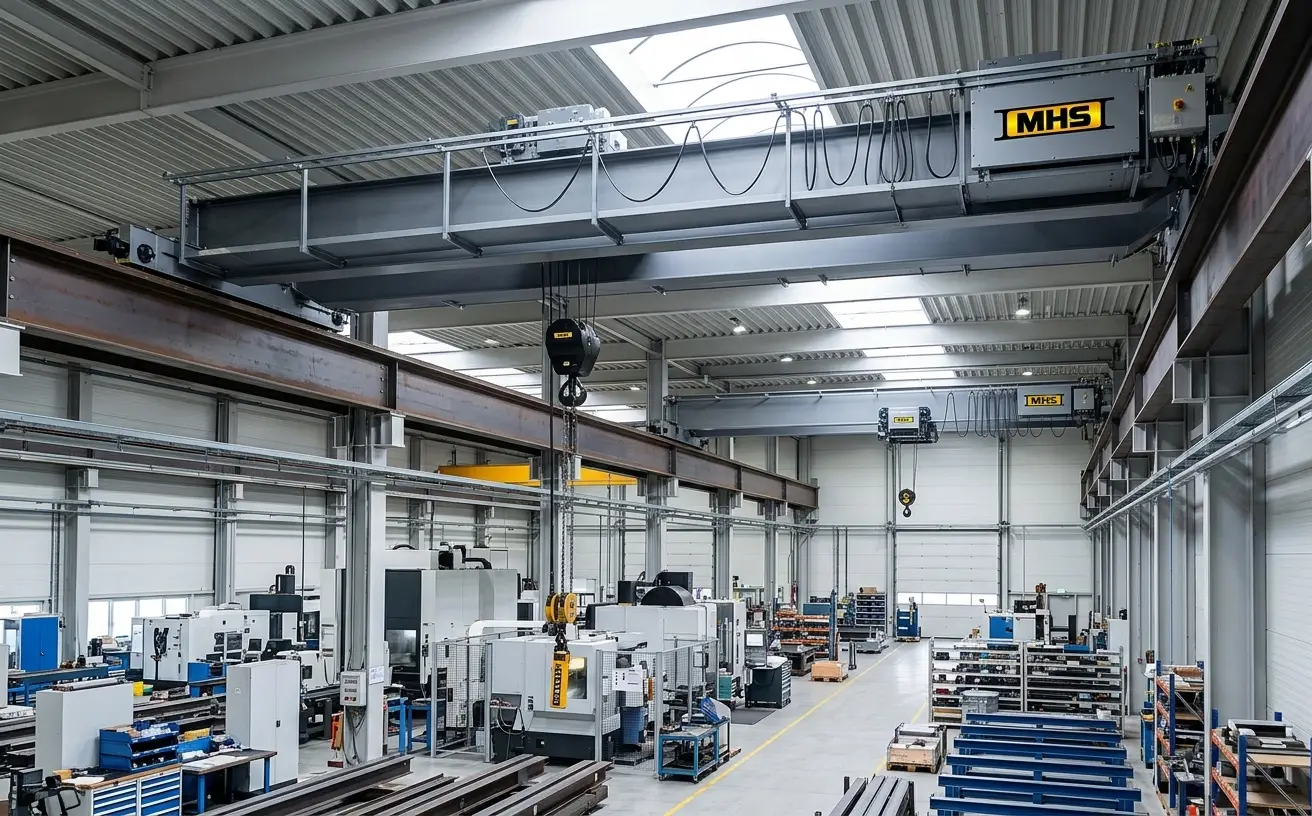
An underhung crane, also called an under-running crane, travels beneath the runway structure, using the lower flange of the runway beam to support the bridge and trolley rather than riding on top of it.
This is the core structural difference from a top-running system: instead of transferring load down through wheels on top of the rail, an under-running bridge crane hangs from the bottom flange, distributing load upward into the building’s existing roof structure, ceiling structure, or roof trusses.
Because underhung systems can often attach to existing building framing rather than requiring dedicated runway support columns, underhung cranes are a common solution where a facility wants to add overhead lifting without major structural modifications. This makes them a practical fit for light manufacturing, maintenance bays, and production lines where a full top-running installation isn’t structurally practical or economically justified.
Top Running vs. Under Running Cranes: What Is the Difference?
The two configurations differ primarily in runway position, lifting capacity potential, headroom requirements, and installation demands on the building’s structure.
Runway Configuration
Top-running cranes operate on top of runway rails, which are mounted on runway beams supported by dedicated crane columns or building columns rated for crane loads. Under-running cranes operate below the runway beams, hanging from the lower flange instead.
This difference directly affects how load transfers into the building. A top-running system pushes load straight down through columns to the foundation and footings. An underhung system pulls load upward into the roof structure, meaning the building’s roof trusses and ceiling structure need to be rated for that suspended load. This is an entirely different structural question than a floor-supported column system.
Lifting Capacity
Top-running configurations generally support higher lifting capacities, since the load path runs through a more direct, stable column-to-foundation route. Heavier lifting applications, such as high-capacity coil handling, stamping facilities, and tool and die work, typically favor a top-running crane for this reason.
Underhung systems can still handle meaningful loads, particularly with a top-running double girder or underhung double girder configuration, but capacity is ultimately governed by the specific crane design and the building’s structural rating, not a fixed rule tied to configuration type alone. A structural survey is the only reliable way to confirm actual capacity limits for either system.
Headroom and Available Space
This is often the deciding factor before capacity ever enters the conversation. An underhung crane’s design frequently offers a meaningful headroom advantage, since it can use existing overhead structure rather than requiring additional runway beam depth and dedicated support columns beneath it.
Facilities with limited headroom, low ceiling clearance, or a building not designed with crane runway support in mind often find that an underhung system captures more usable hook height and lift height within the same building envelope. Top-running systems, by contrast, need appropriate vertical clearance for the runway beam, end trucks, and bridge structure stacked above the hook, which can meaningfully reduce available hook clearance in a building with tight overhead room.
Installation Requirements
Top-running systems typically require dedicated runway support, either new runway support columns or an existing structure engineered specifically for crane loads. This often means more substantial installation costs and, in retrofit situations, significant building reinforcement.
Underhung systems can frequently integrate with existing building structures, provided a structural assessment confirms the roof trusses and columns can carry the suspended load. This can lower installed cost in a retrofit scenario, though greenfield construction removes much of this advantage since the building can simply be engineered for whichever configuration fits the application from the start.
Applications
| Environment | Typical Fit |
| Manufacturing (heavy) | Top running |
| Manufacturing (light) | Underhung |
| Warehouses | Underhung |
| Fabrication facilities | Either, depending on load and building |
| Maintenance areas | Underhung |
| Production lines | Underhung |
| Steel mills, foundries | Top running |
Top Running Crane Advantages
- Higher lifting capacity potential — the direct column-to-foundation load path supports heavier rated loads
- Suitable for demanding industrial applications — steel mills, foundries, and continuous-duty production environments
- Strong runway configuration — dedicated support columns provide a stable, predictable structural system
- Good choice for heavy-duty material handling — matches well with CMAA Class D, E, or F service classifications for high-cycle or severe-duty use
- Flexible span and lifting configurations — accommodates both single girder and double girder designs across a wide range of spans
- Suitable for larger industrial facilities — where floor space for dedicated columns and adequate headroom already exist
Underhung Crane Advantages
- Efficient use of existing building space — attaches to existing roof structure rather than requiring new dedicated support
- Can work well where headroom is limited — captures more usable hook height in buildings with tight vertical clearance
- Flexible runway configurations — adapts more easily to irregular building layouts than a fixed top running system
- Suitable for lighter-duty material handling applications — production lines, workstation-style lifting, and intermittent-duty use
- Can integrate with existing building structures — often reduces the need for major structural modifications
- Useful for production lines and workstation-style lifting — where flexibility and lower installed cost matter more than maximum capacity
Underhung Bridge Crane and Underhung Trolley
Underhung Bridge Crane
An underhung bridge crane is a bridge that travels beneath the runway system rather than on top of it, suspended from the lower flange of the runway beam. This design is common in light manufacturing, maintenance bays, and warehouses where the building’s existing roof structure can support the suspended load without major reinforcement.
Because the bridge hangs rather than rides, underhung bridge cranes are often engineered as single girder systems, though double girder underhung designs exist for higher-capacity applications where headroom is still a constraint.
Underhung Trolley
An underhung trolley is the component that carries the hoist and moves it horizontally along the underhung bridge, operating below the girder rather than on top of it, the same distinguishing feature that defines the crane configuration as a whole.
The underhung trolley is a distinct component from the bridge and runway system: the runway and bridge determine the crane’s overall structural configuration and travel path, while the trolley determines how the hoist moves within that path to position loads precisely.
Structural Assessment: What to Check Before Choosing a Configuration
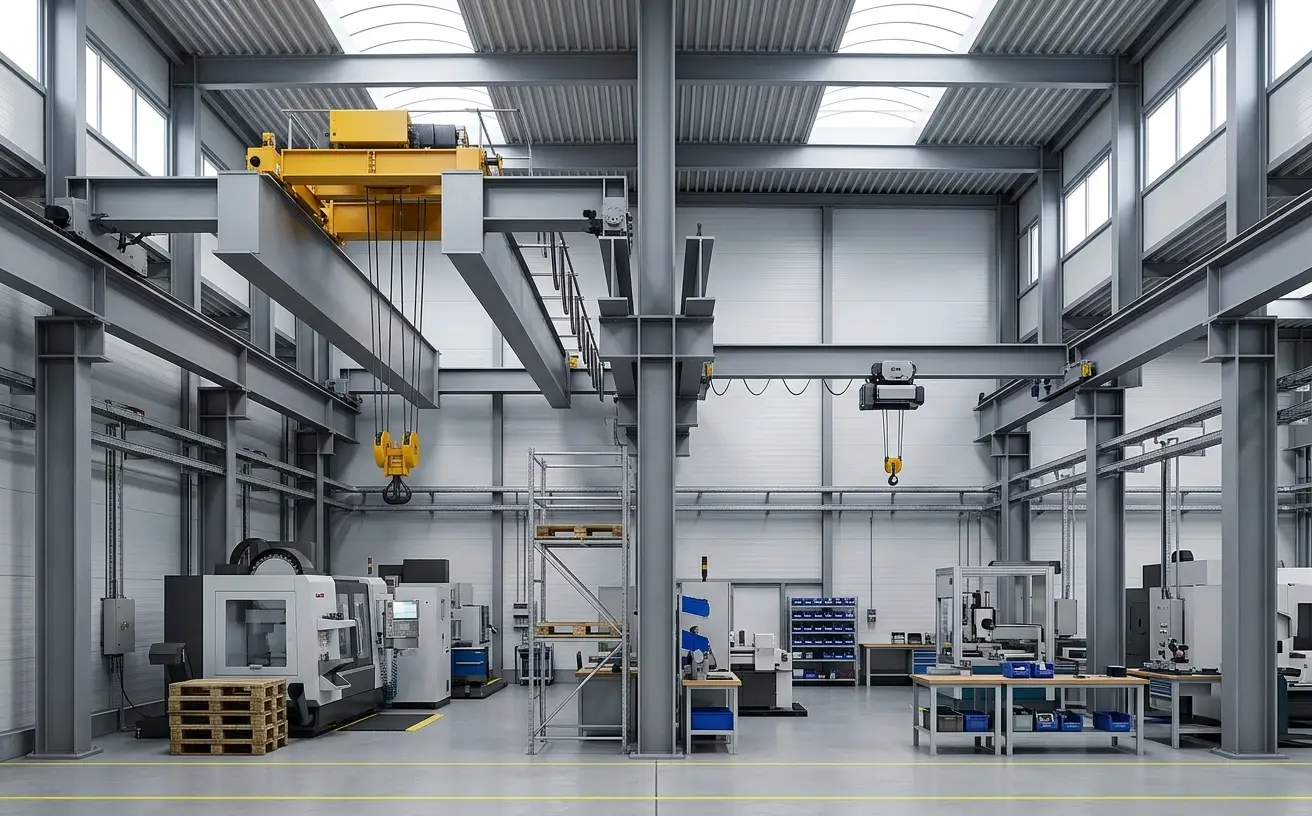
Before selecting between top running and underhung, a facility needs a structural assessment confirming roof load capacity, truss capacity, column ratings, and foundation capacity relative to the specific crane’s rated load.
This step is frequently skipped, and it’s one of the most common sources of costly surprises during installation. Key items an engineering assessment should confirm:
- Roof structure and truss capacity — for underhung systems, whether existing roof trusses and ceiling structure can carry the suspended load without reinforcement
- Building columns and foundation capacity — for top running systems, whether existing columns and footings can support new runway support columns and the resulting load transfer
- Runway interface criteria — alignment and connection standards, per CMAA Specification 74, governing how the crane structure interfaces with the runway
- Deflection limits and allowable stress — structural tolerances that determine how much a given building structure can safely carry under crane loading
A third-party structural survey is the standard way to get an unbiased answer here, particularly in retrofit situations where the building wasn’t originally designed with crane loads in mind. Skipping this step and assuming a building “should be fine” is one of the most common crane selection mistakes facilities make and one of the most expensive to correct after installation.
When Should You Choose a Top Running Crane?
A top running configuration generally makes sense when:
- Lifting requirements exceed what an underhung system can reliably support
- The application involves higher capacity or continuous/heavy-duty cycles (CMAA Class D, E, or F)
- The facility is a larger industrial building with adequate floor space and headroom
- Spans are long, requiring the structural stability a dedicated runway system provides
- The production environment is demanding — steel mills, foundries, paper mills, or coil handling operations
- The facility already has, or can support, dedicated runway support columns built for crane loads
When Should You Choose an Underhung Crane?
An underhung configuration generally makes more sense when:
- Headroom is limited and every inch of hook height matters
- The building has existing structure that can support a suspended load without major reinforcement
- Lifting requirements are light to medium duty rather than continuous heavy-duty
- The application is production-line or workstation-style material handling
- Runway configuration needs to be flexible to match an irregular building layout
- Minimizing structural modifications and installed cost is a priority
Top Running vs. Under Running Cranes: Which Is Right for Your Facility?
| Factor | Top Running | Underhung |
| Runway position | Above bridge/end trucks | Below bridge/end trucks |
| Heavy lifting | Strong fit | Better for lighter applications |
| Headroom | Requires appropriate clearance | Can offer space advantages |
| Building structure | Dedicated runway support | Can use existing structural conditions |
| Typical duty class | CMAA Class D–F | CMAA Class B–D |
| Applications | Heavy industrial | Production/material handling |
| Selection driver | Capacity and facility driven | Space and facility driven |
Neither configuration is automatically better. The right system depends on the facility’s structural capacity, lifting requirements, available headroom, runway structure, and application, as confirmed through an engineering assessment rather than a general preference for one design over the other.
Cost and Lifecycle Considerations
Underhung cranes often have a lower installed cost in retrofit situations, while top-running cranes typically deliver better long-term value for heavy or continuous-duty applications despite higher upfront installation costs.
In an existing building, underhung systems frequently avoid the cost of new runway support columns and major structural modifications, since they can attach to the existing roof structure. This lowers installation costs meaningfully when the structural assessment confirms the building can carry the load.
For greenfield construction, this cost advantage narrows considerably, since the building can be engineered from the start to support whichever configuration the application actually needs.
Lifecycle costs matter beyond installed cost:
- Top running systems built for heavy or continuous duty tend to have lower cost-per-lift over a long service life in high-capacity applications
- Underhung systems in lighter-duty roles often have lower maintenance costs simply because they see less cumulative wear
- Return on investment depends on matching duty cycle and capacity to the actual application — oversizing a top running system for light, intermittent use wastes capital, while undersizing an underhung system for a heavy-duty role increases maintenance costs and shortens crane lifecycle
Common Mistakes When Choosing Between Configurations
- Skipping the structural assessment — assuming an existing building can support one configuration without confirming roof, column, or foundation capacity
- Choosing based on cost alone — a lower installed cost underhung system that’s undersized for actual duty cycle creates higher long-term maintenance costs
- Ignoring future capacity needs — selecting a configuration that fits today’s load but can’t scale with facility growth
- Overlooking hook clearance and wall clearance — a configuration that technically fits can still leave inadequate side approach or end approach for actual operations
- Assuming conversion is simple — switching from underhung to top running (or vice versa) after installation typically requires significant structural changes, not a straightforward retrofit
How MHS Crane Can Help You Choose the Right Overhead Crane
Choosing between top running and underhung configurations starts with engineering, not guesswork. MHS Crane provides full crane system design, custom overhead crane solutions, structural feasibility assessment, crane installation, crane modernization, inspections and maintenance, and repair and component support.
Choose the Right Crane Configuration for Your Application
The core difference between top-running and under-running cranes comes down to how the bridge relates to the runway, above it or below it. That single structural difference drives everything else: capacity, headroom, installation requirements, and cost.
Top-running and underhung cranes serve different facility and lifting requirements, and the right choice depends on evaluating capacity, headroom, runway structure, and application together, not in isolation. Contact MHS Crane for a structural assessment and expert guidance on choosing the right overhead crane configuration for your facility.
FAQs
Q: What is the difference between top running and under running cranes?
A: A top running crane rides on top of the runway rails, while an under-running (underhung) crane travels beneath the runway using the lower flange of the beam. Top running systems generally support heavier loads; underhung systems often work better in tight headroom. The right choice depends on building structure and lifting requirements.
Q: Is a top running crane better than an underhung crane?
A: Neither is universally better — it depends on capacity, headroom, building structure, and application. Top running suits heavier, continuous-duty lifting in larger facilities. Underhung often fits lighter-duty use in buildings with existing structure or limited headroom.
Q: What is an underhung bridge crane?
A: An underhung bridge crane is a bridge that travels beneath the runway system, suspended from the lower flange of the runway beam rather than riding on top of it. It’s common in light manufacturing, maintenance bays, and warehouses. This design often integrates with existing building roof structure.
Q: Are underhung cranes suitable for heavy loads?
A: Capacity depends on the specific crane design and building structure, not the configuration type alone. Underhung double girder systems can handle meaningfully higher loads than a light single girder setup. A structural assessment is needed to confirm actual capacity limits for any given building.
Q: What is an underhung trolley?
A: An underhung trolley carries the hoist and moves it horizontally along an underhung bridge, operating below the girder rather than on top. It’s distinct from the bridge and runway system, which determine the crane’s overall configuration and travel path. The trolley specifically handles horizontal load positioning within that path.
Q: Does switching from an underhung crane to a top running crane require structural changes?
A: Yes, typically — converting between configurations usually requires significant structural modifications rather than a simple retrofit. Top running systems need dedicated runway support columns that an underhung installation likely doesn’t have. A structural assessment is the first step in evaluating whether conversion is feasible.
Q: What CMAA duty class applies to top running vs underhung cranes?
A: Top running cranes are commonly specified for CMAA Class D, E, or F, covering heavy and continuous-duty use. Underhung cranes more often fall into Class B through D, suited to lighter or intermittent-duty applications. Actual classification depends on load frequency and operating hours, not configuration alone.