If you work in a warehouse, workshop, or manufacturing facility, you’ve probably seen a jib crane in action, even if you didn’t know its name. These compact, reliable machines make lifting and moving loads much easier in tight or specific work areas. So, what is a jib crane, and how do you know if one is right for your operation?
This guide breaks it all down in plain language.
What Is a Jib Crane?
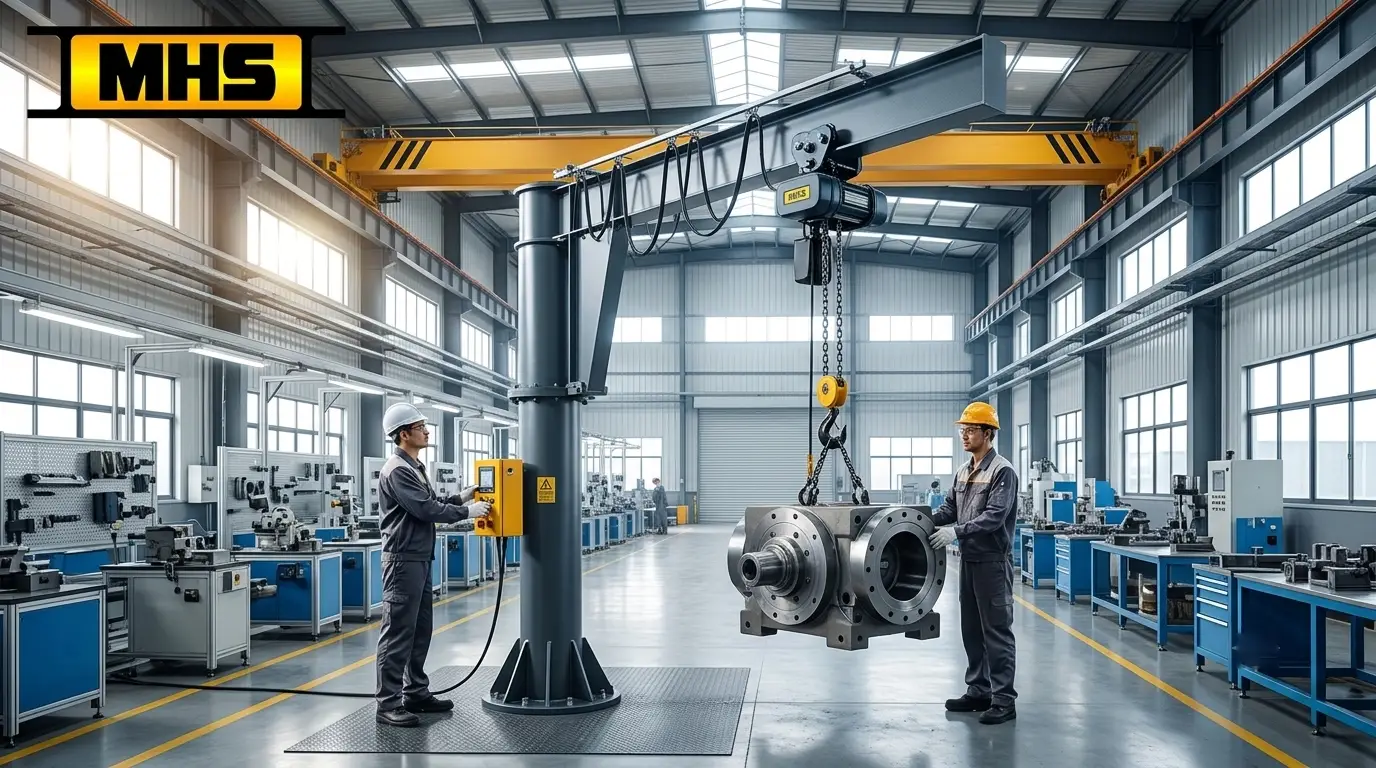
A jib crane is a lifting device built around a single horizontal arm attached to a vertical support. The arm, called the crane jib or boom, extends outward and carries a hoist that moves loads up, down, and along the arm’s length.
Unlike large crane systems that span an entire building, an industrial jib crane focuses on a defined work zone. It handles localized lifting tasks with speed and precision, making it one of the most practical pieces of material handling equipment available.
How a Jib Crane Works
The basic operation is straightforward. The crane jib extends horizontally from a vertical mast or wall bracket. A hoist travels along the length of the boom arm, allowing the operator to position loads precisely within the crane’s working radius.
The entire arm rotates around the vertical support. Depending on the design, this rotation angle can be 180 degrees or a full 360-degree rotation. This slewing motion gives the operator a wide, circular coverage area without moving the crane itself.
The lifting radius, or working radius, is the distance from the mast to the end of the jib arm. This determines how far out a load can be carried. A longer arm means a wider coverage area but may require stronger structural support.
Main Components of a Jib Crane
Every jib crane system shares a set of core parts:
- Mast or support pillar — The vertical column that holds the entire structure. It can be floor-mounted, ceiling-supported, or wall-mounted depending on the design.
- Boom/jib arm — The horizontal arm that extends outward. This is where the hoist and trolley travel.
- Hoist — The lifting mechanism. Options include a chain hoist, wire rope hoist, or electric hoist depending on the load and frequency of use.
- Trolley — The wheeled carriage that moves the hoist along the boom, allowing precise load positioning along the arm’s length.
- Mounting system — This includes the base plate, anchor bolts, wall bracket, or ceiling support depending on the installation type.
Understanding these jib crane components helps you match the right system to your application.
Types of Jib Cranes
Not all jib cranes are built the same. There are several types designed for different environments, load capacities, and workspace requirements.
Freestanding Jib Crane
A freestanding jib crane , also called a free standing jib crane or pillar jib crane , stands on its own floor-mounted base. It doesn’t rely on walls or columns for support. This makes it ideal for large work areas or open production floors where no building structure is nearby.
These are typically heavy-duty lifting machines built for demanding industrial applications. They offer 360-degree rotation and are a strong choice for steel fabrication, machine loading, and heavy assembly operations.
Wall Mounted Jib Crane
A wall mounted jib crane attaches directly to a building wall or structural column. It’s a space-saving lifting solution because it doesn’t take up any floor space.
These cranes typically offer up to 180-degree rotation. They work well in fabrication shops, maintenance areas, and warehouses where floor space is limited. The wall or column must be strong enough to handle the load, so structural assessment is important before installation.
Mast Type Jib Crane
A mast type jib crane is supported at both the base and the ceiling. The mast is anchored to the floor and braced at the top by a ceiling connection. This dual support makes it more stable than a pure floor-mounted pillar crane, especially in medium-duty lifting situations.
It’s a good option when you need a foundationless jib crane that doesn’t require a deep concrete foundation.
Articulated Jib Crane
An articulated jib crane has two arm segments connected by a pivot joint. This allows the arm to fold and reach around obstacles, making it extremely flexible in complex work environments.
This type excels in assembly line settings and ergonomic lifting tasks where rigid arms can’t maneuver into tight spaces. The articulated design improves both workstation efficiency and worker comfort.
Workstation Jib Crane
A workstation jib crane is designed specifically for repetitive lifting at individual workstations. It’s typically lighter than industrial models and is built for speed and ease of use.
These cranes support production workflow by reducing the physical strain of frequent lifting tasks. They are common in assembly operations, packaging lines, and any area where workers move similar loads repeatedly throughout a shift.
Overhead Jib Crane
An overhead jib crane mounts from an elevated structure rather than rising from the floor. It can be ceiling-mounted or attached to an overhead runway system. This design keeps the floor completely clear and works well in facilities with limited ground-level space but adequate headroom above.
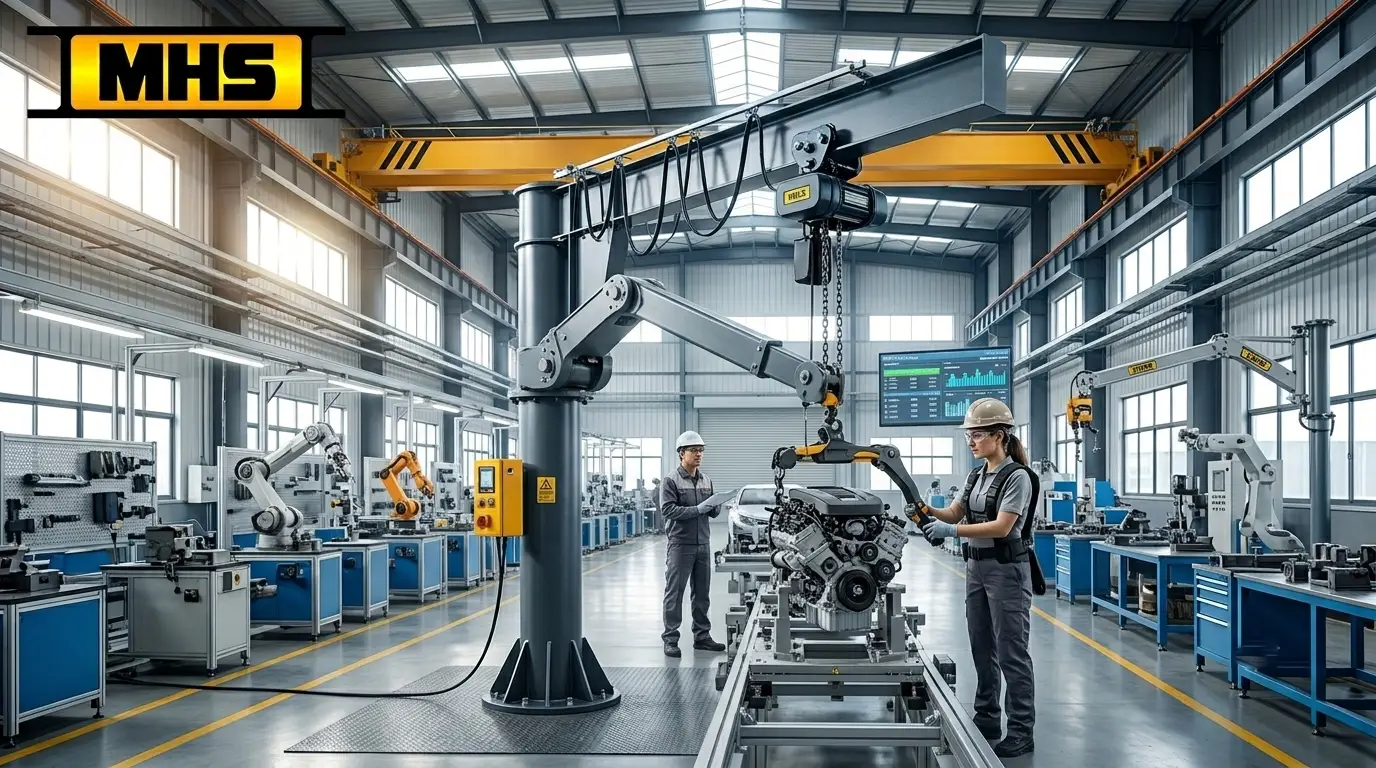
Common Jib Crane Uses and Applications
Jib crane applications are wide-ranging. These machines show up in nearly every type of industrial facility.
Manufacturing Facilities
In a manufacturing facility or on a busy production floor, jib cranes support machine loading, part transfer, and assembly operations. They handle load lifting at individual stations without disrupting the broader workflow.
Warehouses and Distribution Centers
Warehouse lifting equipment needs to be fast and dependable. In a warehouse or distribution center, jib cranes help with loading and unloading, moving heavy inventory, and positioning goods with accuracy. Their compact footprint makes them practical in tight storage environments.
Workshops and Maintenance Areas
In a maintenance shop or fabrication shop, a jib crane gives technicians the ability to lift and reposition heavy parts without manual effort. This improves both workplace safety and operational efficiency.
Material Handling Operations
Across all these environments, the core benefit is the same: better material handling. Jib cranes support safer material movement, reduce repetitive strain on workers, and keep material flow consistent throughout a shift.
Benefits of Using a Jib Crane
The right lifting solution delivers more than just raw power. A well-chosen jib crane improves nearly every aspect of lifting operations.
- Improved productivity — Workers spend less time struggling with heavy loads and more time on productive tasks.
- Reduced worker fatigue — Ergonomic lifting support lowers the physical toll of repetitive lifting, which keeps workers healthier over time.
- Precise load positioning — The combination of hoist movement and arm rotation allows operators to place loads exactly where they need to go.
- Better workspace utilization — Many jib cranes take up minimal floor space while covering a wide working radius.
- Workplace safety — Removing manual lifting from high-frequency tasks reduces injury risk significantly.
- Cost effective lifting solution — Compared to large overhead systems, jib cranes are often easier and less expensive to install and maintain.
Benefits of Portable Jib Cranes
Portable jib cranes add one more advantage: mobility. They can be moved from one area to another, making them a flexible option for smaller operations or facilities that need lifting support in multiple locations.
The benefits of portable jib cranes include easy repositioning, no permanent installation, and adaptability to changing workspace layouts. They’re a practical choice when a fixed crane doesn’t make sense.
Load capacity on portable models tends to be lower than fixed industrial jib crane systems, but they work well for light to medium-duty lifting in flexible environments.
How Do Portable Jib Cranes Work?
Portable jib cranes work on the same basic principle as fixed models , a horizontal arm carries a hoist , but they’re mounted on a weighted or clamped base that can be moved.
Most portable designs use a heavy base plate or counterweight system to keep the crane stable without bolting it to the floor. The operator positions the crane, locks it in place, performs the lift, and can then move the entire unit to a new location.
How do portable jib cranes work in practice? They’re best suited for light material handling, point-of-use lifting, and small workspace lifting where setting up a permanent crane isn’t practical. Portable jib cranes for warehouses are especially useful for seasonal operations or facilities that frequently change their layout.
What Size Portable Jib Crane Do I Need?
Choosing the right size comes down to several key factors.
Load capacity is the starting point. You need a crane rated for the maximum weight you’ll lift, with a safety margin. Never operate a crane at or above its rated capacity.
Lifting height determines how high the hoist can raise a load. Consider the height of the equipment or shelving you’re working around.
Lifting radius tells you how far from the mast the crane can reach. If you need to move loads over a wide area, you need a longer arm.
Available floor space matters too. A portable crane needs room to sit safely and be repositioned without creating hazards.
Frequency of use affects the type of hoist you need. High-frequency operations benefit from a powered movement system like an electric hoist. Occasional lifts may only need a manual chain hoist.
Workspace layout ties it all together. Look at your actual production floor or work area and map out where loads start, where they need to go, and what obstacles are in between.
Getting jib crane capacity right from the start saves time, money, and prevents safety issues down the line.
Jib Crane vs Overhead Crane: What’s the Difference?
Both cranes lift and move loads, but they serve different purposes and suit different environments. Here’s a clear comparison:
| Feature | Jib Crane | Overhead Crane |
| Coverage Area | Limited, circular zone | Larger, rectangular area |
| Rotation | Circular slewing motion | Full runway travel |
| Best Use | Workstations, localized tasks | Large facilities, wide coverage |
| Installation | Easier, lower cost | More complex, higher cost |
| Floor Space | Minimal impact | Requires runway structure |
| Headroom Needed | Moderate | Significant clearance |
The crane coverage area is the biggest practical difference. An overhead crane can move loads across a much larger space. A jib crane is better when the work is concentrated in one zone.
For cost considerations, jib cranes win on installation simplicity. Overhead systems require runway beams, end trucks, and significant structural work. A jib crane can often be operational in far less time and at lower cost.
In many industrial use cases, both types work together. A facility might use an overhead crane for moving loads across the building and jib cranes at individual workstations for precise placement. The overhead jib crane configuration serves as a bridge between the two approaches in some facilities.
When Should You Use a Jib Crane?
A jib crane makes the most sense in these situations:
You have a fixed workstation. If workers in one spot repeatedly lift, rotate, and position loads, a jib crane reduces fatigue and increases speed at that location.
Your lifting zone is small. Jib cranes excel at localized lifting. If you don’t need to move loads across a large area, there’s no reason to invest in a larger overhead system.
You want to supplement an existing system. Many facilities use overhead cranes for broad movement and jib cranes at individual stations. This combination improves both coverage and precision.
You’re operating in a warehouse. Warehouse lifting equipment needs to be practical and space-efficient. Jib cranes fit naturally into warehouse operations without requiring major structural changes.
You need ergonomic lifting support. When repetitive lifting is a concern for worker health, a workstation crane takes the physical load off workers and reduces injury risk over time.
When to use a jib crane comes down to this: if you have a defined lifting zone, a recurring task, and limited floor space, it’s likely the right tool.
Final Thoughts
A jib crane is one of the most versatile and practical pieces of lifting equipment you can add to a workshop, warehouse, or production facility. Whether you need a heavy-duty freestanding unit, a compact wall mounted model, or a flexible portable option, there’s a design to match your needs.
The key is matching the crane to your actual operation, considering load capacity, coverage area, frequency of use, and available space. Choosing the right system means safer workers, better productivity, and smoother material flow.
If you’re still working out which jib crane is right for your specific application, start with the basics: what you’re lifting, how often, and where. Those three answers will point you to the right solution every time.
Frequently Asked Questions
What is a jib crane used for?
Jib cranes are used for lifting, positioning, and moving loads within a defined work area. Common applications include machine loading, assembly operations, warehouse material handling, and maintenance work.
How does a jib crane work?
A hoist moves along a horizontal boom arm, which rotates around a vertical mast. This gives the operator control over both the height and position of the load within the crane’s coverage area.
What are the different types of jib cranes?
The main types include freestanding, wall mounted, mast type, articulated, workstation, and overhead jib cranes. Each type suits different workspace layouts and load requirements.
What size jib crane do I need?
Base your decision on load capacity, lifting height, lifting radius, floor space, and how often you’ll use the crane. When in doubt, consult a lifting equipment specialist before purchasing.
Is a jib crane better than an overhead crane?
Neither is universally better. A jib crane is better for localized, workstation-based lifting. An overhead crane covers a larger area. Many facilities use both.
Can portable jib cranes be used in warehouses?
Yes. Portable jib cranes for warehouses are a practical option for facilities that need flexible, movable lifting support without permanent installation.