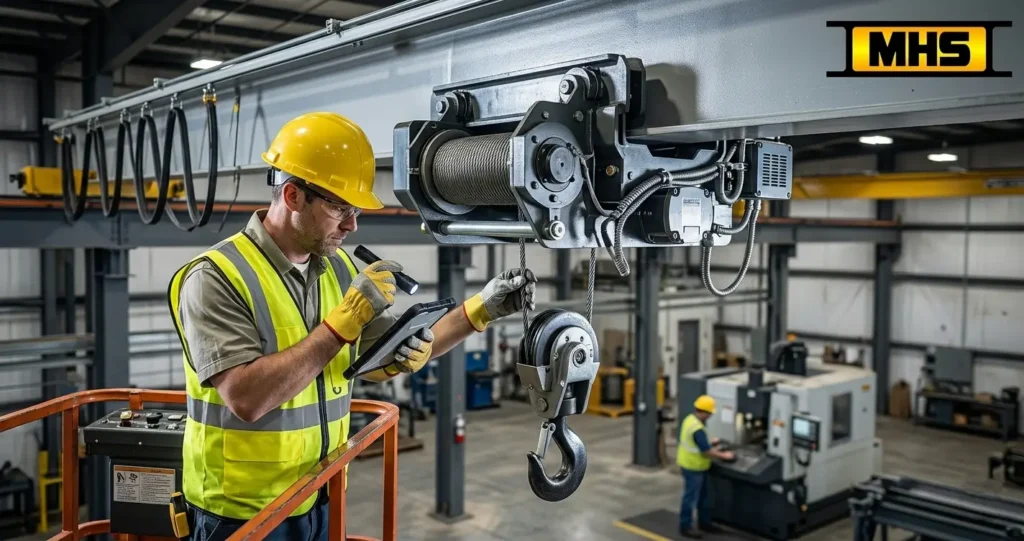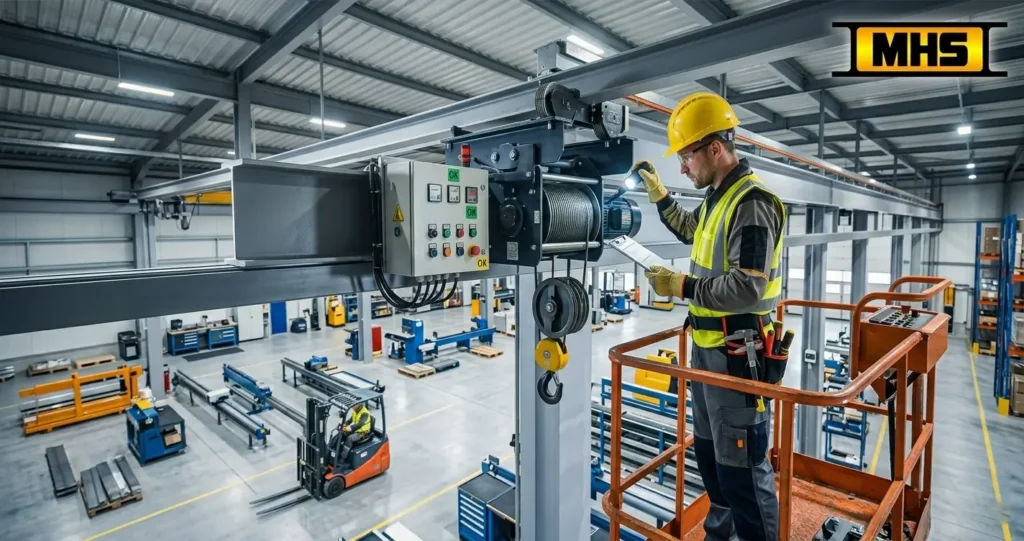
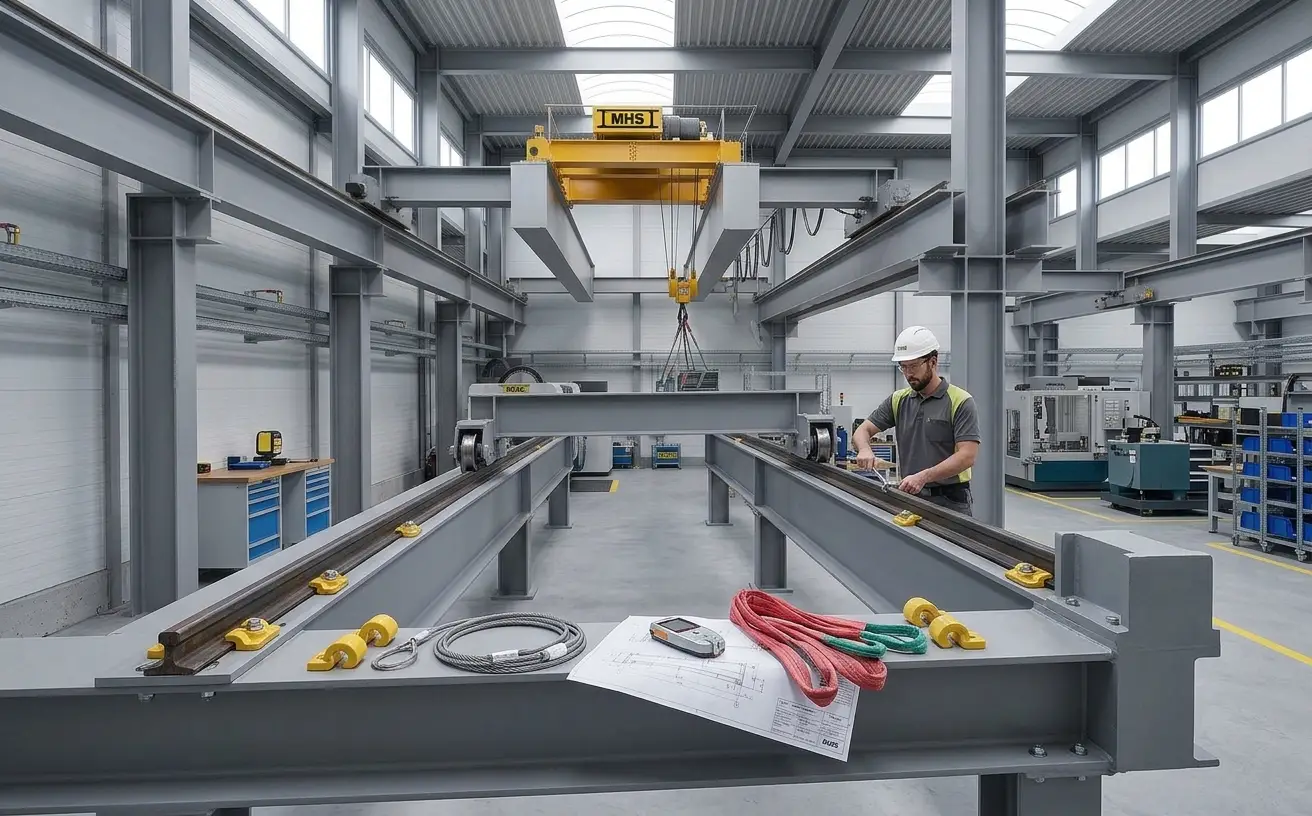
A crane runway system is the supporting structure and travel path that allows an overhead bridge crane to move along the length of a facility. It includes runway beams, rails, rail clips, bumpers, and the structural supports that carry crane loads into the building or a dedicated support structure. Proper design, installation, alignment, inspection, and maintenance all directly affect how safely and reliably the crane operates.
Quick Summary:
- A crane runway system supports and guides crane travel along a fixed path
- Core components are runway beams, rails, rail clips, supports, and bumpers
- Misalignment causes wheel wear, skewing, and premature component failure
- Design, installation, and ongoing inspection all need to work together, not in isolation
Facilities researching crane runway systems are usually in one of three situations: planning a new overhead crane installation, troubleshooting uneven crane travel, or scheduling routine maintenance. This guide covers all three , what the runway system includes, how it’s engineered, and how to keep it operating reliably over time.
What Is a Crane Runway System?
A crane runway system is the fixed structural path , made up of runway beams, rails, and supporting structure , that an overhead crane’s end trucks travel along as the bridge moves the length of a facility.
The crane runway works alongside the crane bridge, not in place of it. The bridge carries the trolley and hoist and moves horizontally across the building’s width. The runway is what the bridge’s end trucks ride on as the entire crane travels the length of the building.
Crane loads transfer through this system in a specific path: the load hangs from the hoist, the hoist sits on the trolley, the trolley rides the bridge, and the bridge’s end trucks carry everything down through the runway rails and runway beams into the building’s structural support , whether that’s existing building columns, dedicated steel columns, or a freestanding crane support structure built specifically for the system.
An overhead crane runway essentially turns a building into a crane’s operating envelope , which is why runway design has to account for the specific crane, not just the building’s general layout.
What Are the Main Components of a Crane Runway?
A crane runway’s main components are the runway beams, runway rails, rail clips, supports and connections, and bumpers or end stops — each handling a distinct structural or safety function.
Crane Runway Beams
A crane runway beam is the primary structural member that supports the rail and carries crane loads down into the building structure or dedicated supports. Runway beams are typically rolled I-section beams, universal beams, or , for longer spans and higher capacities , welded I-section or box girder construction.
Beam selection depends on several structural factors working together: required span, crane capacity, vertical and horizontal wheel loads, and allowable deflection. A bridge crane runway beam undersized for its span or load will deflect excessively under operation, which compounds into rail misalignment and uneven wheel wear over time , this is why runway beam selection is a structural engineering decision, not a generic sizing exercise.
Crane Runway Rails
Crane runway rails sit on top of the runway beam and create the actual travel surface the crane’s wheels ride on. Common rail types include crane rail plates and A-rails, chosen based on wheel load and crane duty cycle.
Proper rail positioning , centered correctly on the beam and running true along its length , directly affects wheel-to-rail contact. An overhead crane rail that’s out of position, even slightly, concentrates wheel load unevenly, which accelerates wear on both the rail and the crane’s wheels.
Crane Rail Clips
Crane rail clips secure the rail to the runway beam, holding it in position while still allowing for the thermal movement rails experience as temperature changes. Properly installed rail clips for cranes keep the rail from shifting laterally under operational loads.
Clip condition matters more than it might seem , a loose or damaged clip allows the rail to creep out of alignment gradually, and that kind of slow drift is often harder to catch during a casual visual check than a sudden, obvious problem would be.
Runway Supports and Connections
Runway supports, columns, brackets, and structural connections carry the combined weight of the runway beam, rail, and all crane loads down into the building’s foundation. These can be existing building columns engineered for crane loads, dedicated runway columns built specifically for the system, or part of a freestanding or semi-freestanding runway structure that doesn’t rely on the building at all.
The structural integrity of these supports is non-negotiable: any compromise here , corrosion, loosened connections, foundation settling, affects the entire runway system above it, not just the local support point.
Crane Bumpers and End Stops
Crane bumpers are positioned at the ends of the runway to limit crane travel and absorb impact if the crane reaches the end of its path. They’re a safety component as much as a mechanical one, preventing the crane from running off the end of the runway or impacting end structures at full travel speed.
End stops and bumpers are sized to the crane’s weight and typical travel speed, so a bumper rated for a light-duty crane isn’t automatically appropriate for a heavier system , matching capacity here matters the same way it does for runway beams and rails.
How Does an Overhead Crane Runway Work?
An overhead crane runway works as a connected sequence, runway beams provide structural support, rails create the travel path, rail clips secure the rails, end trucks and wheels travel along the rails, and the entire structure transfers operational loads into the supporting structure.
Here’s how the full system functions together:
- Runway beams provide the structural backbone, engineered for the crane’s span and capacity
- Rails sit atop the beams, creating the precise travel surface for crane wheels
- Rail clips secure the rails in place while allowing for thermal expansion
- Crane end trucks and wheels travel along the rails as the bridge moves
- The bridge carries the trolley and hoist across its own span, perpendicular to runway travel
- The runway transfers all operational loads — vertical wheel loads, horizontal forces from acceleration and braking, and lateral forces — into the supporting structure below
Every crane runway component depends on the ones around it functioning correctly. A beam engineered perfectly for its load still fails to perform if the rail sitting on it is misaligned, just as a well-aligned rail still wears unevenly if the clips holding it loosen over time.
Crane Runway Design: What Should You Consider?
Crane runway design should account for crane capacity, span, runway length, building structure, support configuration, operating frequency, travel speed, environmental conditions, available headroom, and future expansion needs.
| Design Factor | Why It Matters |
| Crane capacity | Determines vertical and horizontal wheel loads the runway must carry |
| Crane span | Affects beam sizing and deflection limits |
| Runway length | Total travel distance, driving beam count and support spacing |
| Building structure | Determines whether building-supported or freestanding runway fits |
| Support configuration | Column spacing, foundation capacity, connection design |
| Operating frequency | Drives duty classification (FEM or ISO duty class) |
| Travel speed | Affects bumper sizing and dynamic load calculations |
| Environmental conditions | Corrosion protection, thermal movement allowances |
| Available headroom | Influences beam depth and rail selection |
| Future expansion | Whether the runway should allow for added capacity or extended length later |
Crane runway design should always be engineered around the specific crane and facility, not sized generically and hoped to work. A runway designed for a light-duty, intermittent-use crane will underperform and wear prematurely if the facility’s actual operating frequency turns out to be closer to continuous duty. Matching duty classification to actual use early in the design phase prevents this mismatch before it becomes a maintenance problem..
Freestanding vs. Building-Supported Runway Systems
A freestanding crane runway uses its own dedicated columns independent of the building structure, while a building-supported runway attaches to or relies on the facility’s existing structural framing.
A freestanding runway system makes sense when the existing building wasn’t engineered to carry crane loads, or when the facility wants the runway structurally independent for flexibility in future modifications. This approach avoids the need for building reinforcement but adds the cost of dedicated columns and foundations.
A building-supported crane system uses the facility’s existing columns and structure, which can lower installation cost when that structure is already rated to handle the added load, but it requires a structural assessment to confirm the building can actually support it before installation begins.
A semi-free-standing crane runway splits the difference, using partial building support on one side and independent columns on the other, a practical option when a facility has structural capacity on part of the span but not the whole length.
Crane Runway Installation: What You Need to Know
Crane runway installation follows a structured sequence, initial structural assessment, runway layout, beam and support installation, rail positioning, rail clip installation, alignment and leveling, bumper installation, crane integration, and final inspection and testing.
The installation process, step by step:
- Initial facility and structural assessment — confirming the building or dedicated support structure can carry the runway and crane loads
- Runway layout — establishing the precise path, span, and support positions based on the design
- Beam and support installation — setting runway beams and columns according to engineered specifications
- Rail positioning — placing rails accurately on the beams before securing
- Rail clip installation — securing rails while preserving allowance for thermal movement
- Alignment and leveling — verifying rail parallelism, elevation, and positioning meet tolerance
- Installation of bumpers and end stops — sized and positioned to the crane’s weight and travel speed
- Crane integration — installing the crane itself onto the completed runway system
- Final inspection and testing — confirming the full system operates within design tolerances before operational release
Skipping or rushing the alignment and leveling step is one of the most common sources of long-term problems. A runway that’s installed slightly out of tolerance will still function initially, but misalignment compounds, it doesn’t resolve itself with use.
Crane Runway Alignment: Why Does It Matter?
Crane runway alignment matters because even small deviations in rail parallelism, elevation, or positioning cause uneven wheel-to-rail contact, which leads to crane skewing, accelerated wear, and increased strain on drive components.
Runway alignment covers several specific measurements:
- Rail parallelism — whether the two runway rails run precisely parallel along their full length
- Rail elevation and positioning — whether both rails sit at the correct height and lateral position relative to each other
- Wheel-to-rail contact — whether crane wheels make even, full contact with the rail surface
What happens when alignment is off:
- Crane skewing — the bridge travels at a slight angle instead of straight, forcing wheels to fight the rail rather than roll freely
- Wheel and rail wear — uneven contact concentrates stress on specific points rather than distributing it evenly, wearing down both components faster than normal
- Stress on drive components — motors and gearing work harder to overcome resistance from a misaligned system, shortening their service life
- Reduced operational reliability — crane travel becomes less predictable, and unplanned downtime for repairs increases
Overhead crane runway alignment isn’t a one-time installation concern — thermal movement, foundation settling, and normal operational wear all shift alignment gradually over time, which is why verification needs to happen on a recurring schedule, not just after initial installation.
What Is a Crane Rail Survey?
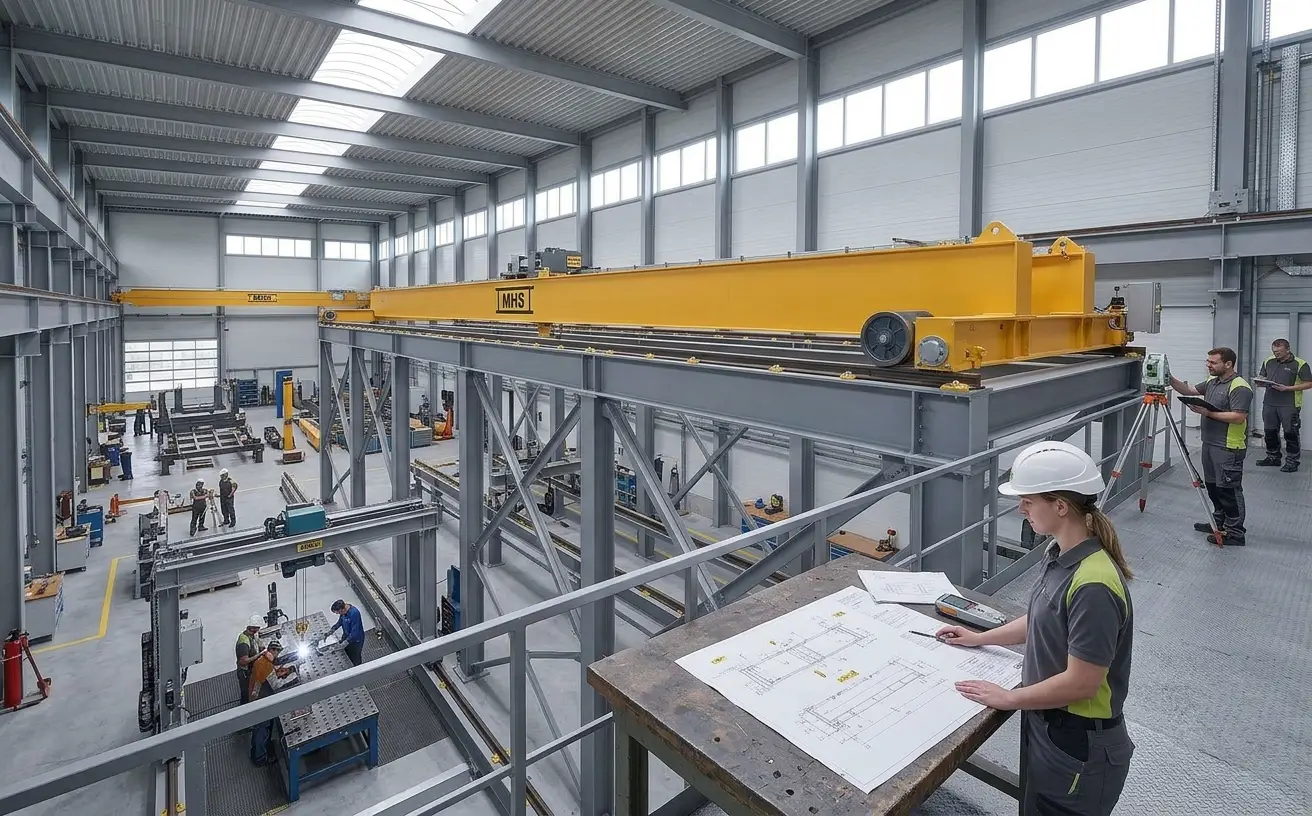
A crane rail survey is a precise measurement process that checks runway rail position, elevation, span, and parallelism to identify alignment or structural issues before they cause operational problems.
A crane rail survey typically measures:
- Rail elevation at multiple points along the runway length
- Rail span (the distance between the two parallel rails)
- Rail parallelism and straightness
- Deviation from design tolerances at each measured point
This process directly connects to runway alignment and maintenance, a rail survey is often the diagnostic step that confirms whether observed problems (uneven crane travel, unusual wear, skewing) actually stem from alignment issues, and precisely where along the runway those issues exist.
A crane rail survey is particularly useful after a facility notices changes in crane travel behavior, after a building settles or undergoes structural changes, or as part of a scheduled maintenance interval for critical or high-duty-cycle crane systems. It provides objective, measured data rather than relying on visual inspection alone, which matters when the goal is catching gradual misalignment before it becomes a larger structural or safety issue.
Crane Runway Inspection: What Should Be Checked?
A thorough crane runway inspection checks runway beam condition, rail condition, rail clips, supports and connections, bumpers and end stops, rail alignment, wheel-to-rail interaction, and signs of structural wear or damage.
| Inspection Area | What to Check |
| Runway beams | Deflection, corrosion, structural damage |
| Rails | Wear, surface damage, positioning |
| Rail clips | Looseness, damage, missing clips |
| Supports/connections | Corrosion, loosened fasteners, foundation condition |
| Bumpers/end stops | Impact damage, proper positioning |
| Rail alignment | Parallelism, elevation, deviation from tolerance |
| Wheel-to-rail interaction | Even contact, unusual wear patterns |
| Crane travel behavior | Skewing, noise, vibration, changes from baseline |
Runway inspection works alongside — but isn’t a substitute for — broader crane inspection covering the bridge, hoist, and electrical systems. The runway is the foundation the entire crane operates on, so a problem there affects crane performance even when every other component checks out fine.
Crane Runway Maintenance: Best Practices
Reliable crane runway maintenance combines regular inspections, rail wear monitoring, alignment checks, and prompt attention to early signs of damage, documented consistently over time.
Core maintenance practices:
- Scheduling regular runway inspections, not just reacting to visible problems
- Monitoring rail wear patterns over time to catch gradual deterioration
- Checking rail clip condition and tightness
- Verifying alignment on a recurring schedule, not only after an incident
- Inspecting beams and supports for structural wear or corrosion
- Inspecting crane bumpers for impact damage or positioning drift
- Monitoring wheel and rail wear together, since each affects the other
- Addressing damage early, before it compounds into a larger structural or safety issue
- Documenting inspection and maintenance findings for trend tracking over time
Maintenance requirements vary depending on the crane’s duty cycle, operating conditions, manufacturer recommendations, and applicable industry requirements — a runway supporting continuous, heavy-duty operation needs a tighter inspection interval than one supporting light, intermittent use. Matching the maintenance schedule to actual operating conditions, rather than applying a generic interval across every installation, is what keeps a runway system reliable long-term.
Signs Your Crane Runway System Needs Attention
- Crane movement becomes uneven during travel
- Crane begins to skew rather than tracking straight
- Wheels show unusual or uneven wear
- Rails show visible damage, flattening, or wear
- Unusual noise or vibration occurs during crane travel
- Rail clips appear damaged, loose, or missing
- Bumpers or end stops show impact damage
- Runway measurements indicate the system has drifted outside tolerance
- Structural components show visible deterioration or corrosion
- Overall crane travel performance has noticeably changed from baseline
A practical rule: Any single sign on this list is worth investigating, but a crane showing two or more of these symptoms together usually indicates the runway system needs more than a minor adjustment. A full rail survey and structural inspection is the appropriate next step rather than a spot fix.
How Poor Crane Runway Alignment Affects Crane Performance
Poor runway alignment creates a cascading effect, it accelerates wheel and rail wear, strains drive components, causes crane skewing, increases maintenance frequency, reduces operational efficiency, and can eventually create safety concerns.
The relationship works like this: misalignment forces wheels into uneven contact with the rail, which concentrates wear at specific points instead of distributing it evenly. That uneven wear increases resistance during travel, which forces drive motors and gearing to work harder than designed, shortening their service life. Over time, this shows up as crane skewing, where the bridge no longer tracks straight along the runway.
Left unaddressed, this cycle compounds: increased maintenance frequency, reduced operational efficiency, and, in more advanced cases, premature component failure that creates genuine safety concerns rather than just a performance inconvenience. This is why overhead crane runway alignment gets treated as a priority maintenance item rather than a cosmetic concern, the costs of ignoring it grow, they don’t stay flat.
Crane Runway vs. Crane Bridge: What’s the Difference?
The crane runway is the fixed structural path and supporting structure the crane travels along; the crane bridge is the moving horizontal structure that carries the trolley and hoist across that path.
| Component | Function |
| Crane runway | Fixed travel path and supporting structure |
| Crane bridge | Moving horizontal structure carrying trolley and hoist |
| Relationship | The bridge travels along the runway rails |
The runway doesn’t move — it’s the engineered path the crane operates within, built from beams, rails, and supports. The bridge is the mobile component riding on that path, with its own trolley and hoist handling load movement across the bridge’s span. Both systems work together, but they serve entirely different structural roles: one provides the route, the other does the moving.
This distinction matters practically when diagnosing a problem — a runway issue (misalignment, worn rails, damaged clips) and a bridge issue (trolley wear, hoist malfunction) require different inspection approaches and often different corrective actions.
How to Maintain a Reliable Crane Runway System
- Start with proper runway design, engineered around the specific crane and facility
- Use appropriate beams and rails matched to capacity, span, and duty classification
- Install rails and clips correctly, verified against design tolerances
- Verify alignment immediately after installation, not just assumed from the design
- Perform regular inspections on a schedule matched to operating conditions
- Conduct rail surveys when travel behavior changes or at scheduled intervals
- Address wear and damage early, before it compounds into larger issues
- Maintain bumpers, supports, and connections as part of routine inspection, not as an afterthought
- Monitor crane travel performance over time, watching for gradual changes from baseline
- Keep inspection and maintenance records to track trends and support long-term planning
Keep Your Crane Runway System Safe and Reliable
A crane runway system only works as well as its weakest component, proper design, careful installation, verified alignment, and consistent inspection and maintenance all need to work together to keep an overhead crane operating safely and reliably.
MHS Crane brings engineering and technical expertise to crane runway alignment, inspection, repair, and related crane services, helping facilities catch problems early and keep runway systems performing the way they were designed to.
Contact MHS Crane to request a quote or schedule a crane runway assessment for your facility.
Frequently Asked Questions
Q: What is a crane runway system?
A: A crane runway system is the fixed structural path — made up of beams, rails, and supports — that an overhead crane’s end trucks travel along. It carries crane and load weight into the building structure or dedicated supports. The crane bridge, trolley, and hoist all depend on it functioning correctly.
Q: What are the main components of a crane runway?
A: The main components are runway beams, rails, rail clips, supports and connections, and bumpers or end stops. Each handles a distinct structural or safety role, from carrying load to securing the rail to limiting travel. Together they form the complete runway system.
Q: What is a crane runway beam?
A: A crane runway beam is the primary structural member supporting the rail and carrying crane loads into the building or dedicated support structure. It’s typically a rolled I-section, universal beam, or welded girder, sized to the crane’s span and capacity. Undersized beams deflect excessively and cause downstream alignment problems.
Q: What is an overhead crane rail?
A: An overhead crane rail sits on the runway beam and creates the travel surface for crane wheels. Proper rail positioning directly affects how evenly crane wheels make contact, which influences wear rate and crane travel smoothness. Rail type is selected based on wheel load and duty cycle.
Q: What are crane rail clips used for?
A: Crane rail clips secure the rail to the runway beam while allowing for thermal movement as temperatures change. Loose or damaged clips let the rail shift out of position gradually, often without an obvious, sudden symptom. Regular inspection catches this kind of slow drift before it becomes a bigger alignment issue.
Q: Why is crane runway alignment important?
A: Misaligned rails cause uneven wheel-to-rail contact, leading to crane skewing, accelerated wear, and added strain on drive components. Left unaddressed, this reduces operational reliability and increases maintenance costs over time. Alignment should be verified on a recurring schedule, not only after a problem appears.
Q: What is a crane rail survey?
A: A crane rail survey is a precise measurement of rail position, elevation, span, and parallelism, used to identify alignment or structural issues. It’s especially useful after a facility notices changes in crane travel behavior or after structural changes to the building. It provides objective data rather than relying on visual inspection alone.
Q: How often should a crane runway be inspected?
A: Inspection frequency depends on the crane’s duty cycle, operating conditions, and manufacturer recommendations — continuous, heavy-duty systems typically need more frequent checks than light, intermittent-use systems. Regular inspection should cover beams, rails, clips, supports, bumpers, and alignment.
Q: What causes crane runway misalignment?
A: Common causes include foundation settling, thermal movement over time, normal operational wear, and installation that wasn’t verified against design tolerances. Misalignment tends to develop gradually rather than appear suddenly. Regular alignment checks and rail surveys catch this before it compounds into bigger problems.
Q: What are crane bumpers used for?
A: Crane bumpers sit at the ends of the runway to limit crane travel and absorb impact if the crane reaches its travel limit. They’re sized to the crane’s weight and typical travel speed. As a safety component, damaged or improperly sized bumpers should be addressed as a priority during inspection.