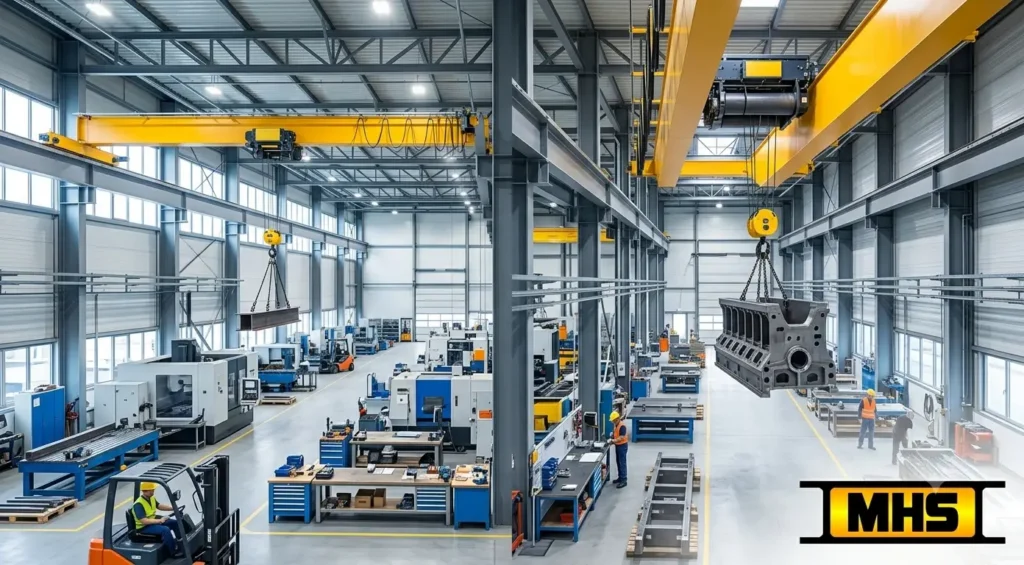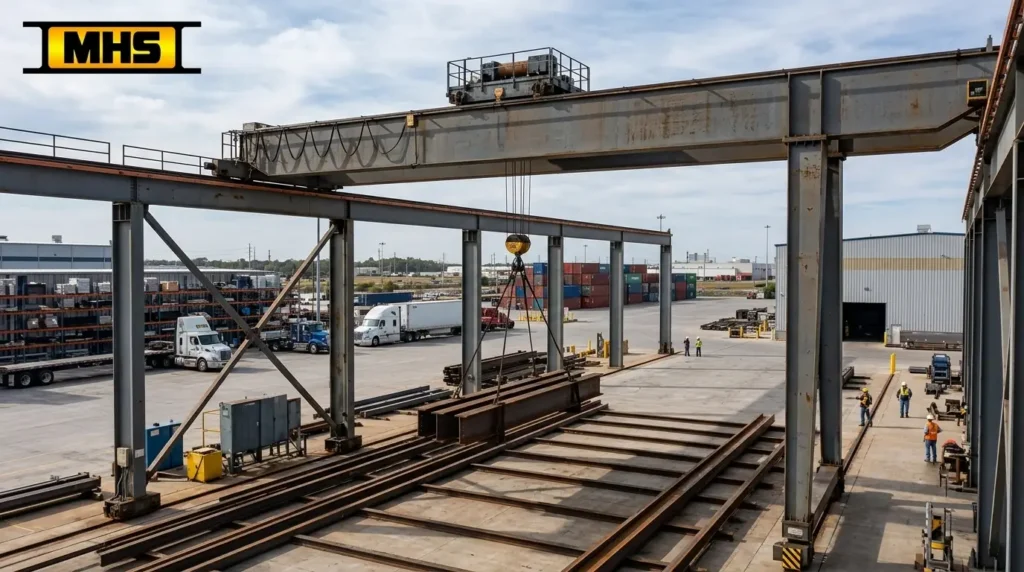
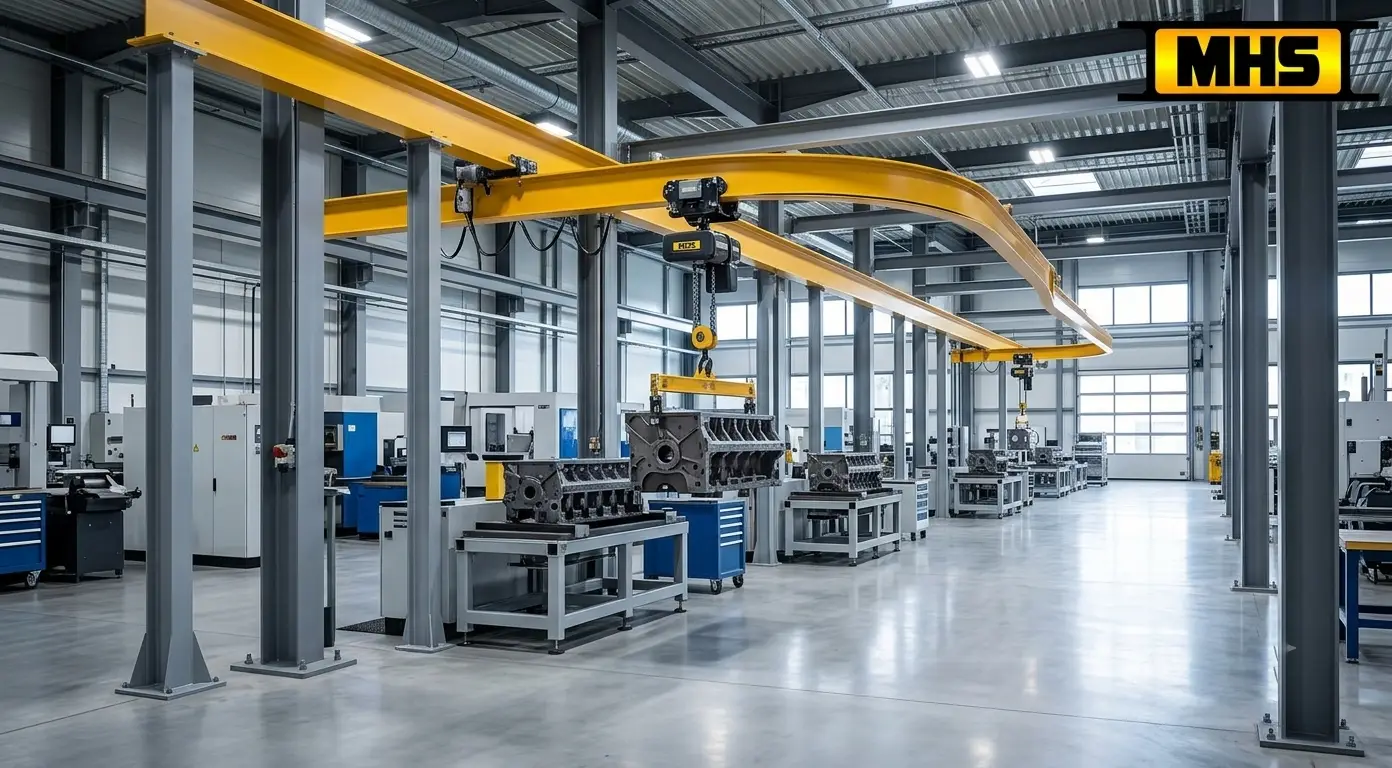
A monorail crane system is an overhead lifting system that uses a single fixed runway beam to move loads along a defined path. Manufacturing facilities, warehouses, and industrial plants use these systems to improve material movement, cut down on manual handling, and increase operational efficiency.
In Short :
- A monorail crane system moves loads along one fixed beam, not multiple directions
- Freestanding and overhead configurations fit different building types
- Best suited for repetitive, point-to-point material transfer
- Lower installation and maintenance costs than multi-directional crane systems in many cases
Facilities that move the same load along the same route, day after day, often outgrow forklifts and manual carts fast. A monorail crane solves that problem by giving the load a fixed, predictable path – no steering, no aisle traffic, no wasted motion.
MHS Crane has spent years designing custom material handling systems for facilities of every size, from single workstation setups to full production lines. This guide breaks down how a monorail crane system works, where it fits, and how to decide if it’s the right investment for your facility.
What Is a Monorail Crane System?
A monorail crane system is an overhead material handling solution where a hoist and trolley travel along a single runway beam to transport materials between fixed points in a facility.
Unlike a bridge crane, which moves side to side across a wide bay, a monorail crane follows one line – straight, curved, or looped – from point A to point B. That simplicity is the whole point: fewer moving parts, fewer failure points, and a load path that never changes.
How Does a Monorail Crane Work?
The system starts with a monorail beam mounted overhead, either suspended from the ceiling or supported by dedicated columns. A trolley rides along this beam, and a monorail hoist hangs below it to lift and lower the load.
The load handling process, step by step:
- The operator (or automated control) positions the trolley above the load
- The monorail hoist crane lowers, attaches to the load, and lifts it clear
- The trolley carries the load along the fixed beam toward its destination
- The hoist lowers the load and releases it at the endpoint
Movement along the beam is restricted to forward and backward travel — there’s no side-to-side movement once the beam is set. Some systems run on manual trolleys with pendant controls. Others use a PLC controlled crane setup, where a programmable logic controller runs the entire cycle without an operator guiding each trip. Larger installations sometimes add a radio remote control for operators who need to stay clear of the load path.
Main Components of a Monorail Crane System
| Component | Function |
| Monorail beam | Fixed track the trolley travels on |
| Electric hoist | Lifts and lowers the load |
| Trolley system | Moves the hoist along the beam |
| Runway structure | Supports the beam and carries the load weight |
| Controls | Pendant, remote control system, or automated PLC |
| Support structures | Columns, brackets, or ceiling mounts holding the system in place |
Each part can typically be serviced or replaced on its own, which keeps long-term monorail crane maintenance costs lower than systems with more interconnected moving parts.
Types of Monorail Crane Systems
Monorail crane systems come in three main configurations – freestanding, overhead, and automated conveyor – each suited to different building types and workflow needs.
| Type | Support Structure | Best Fit |
| Freestanding | Independent columns, not building-dependent | Buildings not rated for overhead loads |
| Overhead | Ceiling or roof structure | Facilities with adequate structural capacity |
| Automated conveyor | Fixed track, motor-driven | High-repetition production lines |
Freestanding Monorail Crane Systems
A freestanding monorail crane uses its own support columns instead of relying on the building’s roof or ceiling structure. This makes it a strong option when the existing building wasn’t engineered to carry overhead crane loads, since it avoids the cost and complexity of a full building reinforcement project.
Freestanding systems also give facilities more flexibility during crane installation, since the support structure can go wherever the workflow needs it – not just where the ceiling happens to be strong enough.
Overhead Monorail Crane Systems
An overhead monorail system attaches directly to the building’s existing roof or ceiling structure. This works well when a facility already has sufficient roof load capacity and ceiling load capacity, since it skips the added cost of dedicated support columns.
Because the beam hangs from above, the floor stays completely open. Workers, forklifts, and other equipment move underneath the monorail overhead crane without any obstruction – a real advantage in facilities with limited floor space.
Automated Monorail Conveyor Systems
A monorail conveyor takes the concept a step further by removing the operator from the equation entirely. Loads move along the track automatically, guided by sensors and programmed stop points.
This setup fits assembly line automation environments especially well, where the same part needs to travel the same route hundreds of times per shift. Automated material handling systems like this reduce labor costs and keep production moving at a steady, predictable pace.
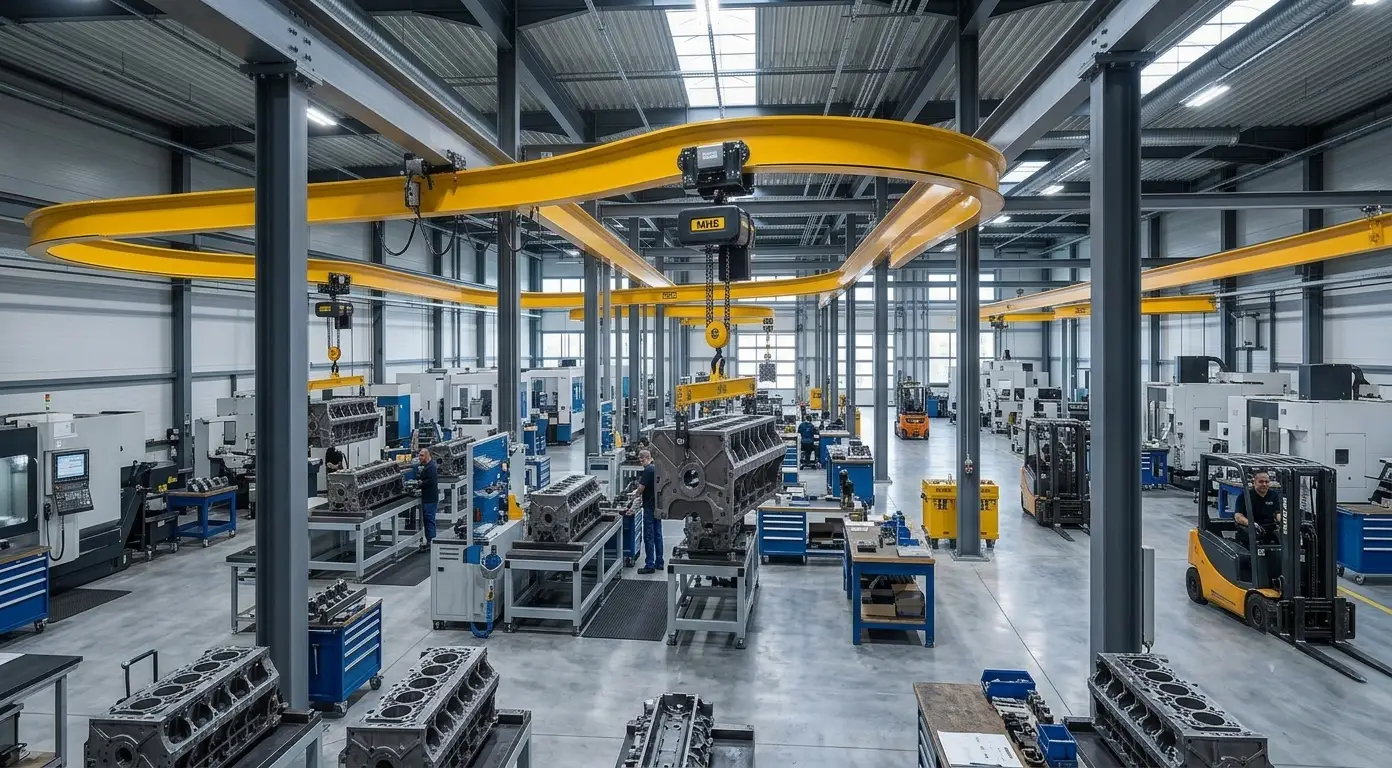
Benefits of Using a Monorail Crane System
A monorail crane system improves productivity by delivering efficient, controlled, and safer material movement, while using less floor space and fewer moving parts than multi-directional crane systems.
Improved Material Handling Efficiency
Because the load path never changes, workers don’t need to plan a new route for every trip. That consistency speeds up production line material handling and removes a common source of delay on busy floors.
Facilities running high-volume, repetitive transfers – like moving parts from one workstation to the next – see the biggest efficiency gains from this kind of fixed travel path.
Space-Saving Industrial Lifting Solution
A monorail system uses overhead space that would otherwise sit empty. Floor areas stay clear for foot traffic, equipment, or storage, which matters most in facilities with a small facility crane need but limited square footage.
This overhead space utilization is one reason monorail systems are common in older buildings where floor space was never designed with material handling equipment in mind.
Increased Workplace Safety
Manual lifting is one of the most common sources of industrial injury. A monorail crane removes much of that risk by handling the heavy work along a controlled, predictable path.
Systems built to current OSHA compliance standards include safety features like overload protection and automatic stops, giving facility managers a documented, repeatable safety process rather than relying on manual technique alone.
Lower Installation and Maintenance Costs
Compared to multi-directional bridge or gantry systems, a monorail crane system typically has fewer moving parts and a simpler support structure. That translates into a lower installation cost upfront and lower maintenance cost over the system’s service life.
A guardrail worth noting: lower cost doesn’t mean lower capacity. Monorail systems scale from light-duty workstation use up to heavy-duty industrial loads – the cost advantage comes from structural simplicity, not reduced capability.
Customizable for Different Industries
No two facilities move materials the same way. Custom monorail systems are engineered around each site’s layout, load size, and daily workflow – including curved track, branch track, or multi-trolley configurations where a single straight beam won’t cover the workflow.
Common Applications of Monorail Crane Systems
Monorail cranes are used across manufacturing, warehousing, and fabrication industries wherever materials need to move repeatedly along a fixed, predictable path.
Manufacturing Facilities
On assembly lines, parts often travel the same short distance over and over. A monorail crane handles this repetitive material handling without slowing production – a natural fit for automotive manufacturing and general assembly line material handling.
Warehouses and Distribution Facilities
In warehouses, monorail systems move inventory between storage areas and loading docks. This kind of warehouse material handling keeps goods moving steadily, even during peak shifts, without adding forklift traffic to the floor.
Fabrication Shops and Industrial Plants
Heavy components – steel beams, machine parts, large assemblies – are difficult and risky to move by hand. A monorail crane handles this heavy material movement safely, cutting down on strain injuries and product damage.
Specialized Environments
Food processing facilities use monorail systems for big bag handling and ingredient transfer, where a fixed, sanitary path matters. Mining applications, including salt mining operations, use heavy-duty monorail configurations built for continuous, high-cycle use in demanding conditions.
Monorail Crane vs Overhead Crane: What Is the Difference?
The core difference is movement – a monorail crane follows one fixed path, while an overhead bridge crane moves in multiple directions across a wider bay.
| Feature | Monorail Crane | Overhead Crane |
| Movement | Fixed, linear travel path | Multi-directional movement |
| Structure | Single runway beam | Bridge and runway system |
| Installation cost | Generally lower | Generally higher |
| Best for | Repetitive point-to-point transfer | Flexible lifting across a wide area |
| Applications | Production lines, fixed workflows | Manufacturing bays, warehouses with varied load points |
A monorail crane makes sense when loads always travel the same route. An overhead crane makes more sense when loads need to move to different points across a wide area. Many facilities run both systems side by side, using each where it fits best.
How to Choose the Right Monorail Crane System for Your Facility
Consider Your Load Requirements
Start with weight capacity, material type, and how often the crane will run. A light – duty crane built for occasional transfers looks very different from a medium – duty crane running continuous shifts – duty cycle and lift frequency should drive the spec, not just maximum load.
Evaluate Facility Layout
Look at available space, existing structures, and current production workflow. This determines whether a freestanding or overhead monorail system fits better, and whether the building can support an existing building retrofit or needs new support columns entirely.
Work With Experienced Crane Engineers
Sound crane engineering is the difference between a system that fits the facility and one that creates bottlenecks within a year. Partnering with a provider offering full crane installation services means the design, installation, and ongoing support come from the same team that understands the load and layout from day one.
Monorail Crane Installation, Repair & Maintenance
Professional monorail crane installation covers more than mounting a beam – it includes structural evaluation, load testing, and safety verification before the system goes into service.
Ongoing support includes:
- Preventive maintenance — scheduled checks that catch wear before it causes downtime
- Crane inspection — routine reviews confirming the system still meets safety standards
- Monorail crane repair — fast turnaround when components fail
- Crane modernization — upgrading older systems with automation or improved controls
Skipping routine inspection is one of the most common – and costliest – mistakes facilities make with any overhead lifting equipment. A missed wear point on a trolley wheel or hoist cable rarely causes problems immediately, but it compounds into unplanned downtime later.
Why Choose MHS Crane for Monorail Crane Systems?
MHS Crane brings decades of experience to every project, with certified technicians who understand the structural and safety details that generic installers often miss.
We design custom crane systems around your facility’s actual layout and workload, not a one-size-fits-all template. From initial site evaluation through installation, inspection, and long-term maintenance, our team provides the kind of industrial crane solutions that hold up under real production demands.
Final Thoughts
A well-designed monorail crane system improves efficiency and safety while cutting down on manual labor and floor congestion. It’s the right fit for any facility that moves materials the same way, repeatedly, along a fixed route.
Custom engineering ensures the system matches your load, your layout, and your workflow – not a generic template. Contact MHS Crane for custom monorail crane systems, installation, repairs, and material handling solutions built around your facility’s needs.
FAQs
What is a monorail crane system used for?
A monorail crane system moves materials repeatedly along a fixed overhead path, commonly in manufacturing, warehousing, and fabrication settings. It works best where the same load needs to travel the same route regularly. Facilities with varied load destinations typically pair it with other equipment.
How does a monorail crane work?
A hoist and trolley travel along a single fixed beam, lifting the load and carrying it to a set destination point. Movement is restricted to forward and backward travel along the beam, with no side-to-side motion. Controls range from manual pendants to fully automated PLC systems.
What is the difference between a monorail crane and an overhead crane?
A monorail crane follows one fixed path using a single runway beam, while an overhead crane moves in multiple directions across a bridge and runway system. Monorail systems typically cost less to install and suit repetitive transfers. Overhead cranes suit facilities needing flexible lifting across a wider area.
Does a monorail crane system require building structural support?
It depends on the configuration – overhead monorail systems attach to existing roof or ceiling structures, while freestanding systems use independent support columns instead. A structural evaluation determines which option fits a given building. Buildings not rated for overhead loads typically require the freestanding approach.
How much does monorail crane installation cost?
Cost depends on load capacity, beam length, and whether the building needs structural reinforcement or new support columns. Freestanding systems often cost more upfront due to added structure, while overhead systems save on support costs if the building already qualifies. An on-site evaluation gives the most accurate estimate.
What industries commonly use monorail crane systems?
Manufacturing, warehousing, fabrication, food processing, and mining industries all use monorail systems for repetitive material transfer. Automotive assembly lines are a particularly common application due to consistent, high-volume part movement. The common thread is a fixed, repeatable load path.
Can an automated monorail conveyor replace manual operation entirely?
Yes, automated monorail conveyor systems use sensors and programmed stop points to move loads without an operator guiding each trip. This works best for high-repetition production line applications. Facilities with variable or occasional loads often still benefit from manual or semi-automated control instead.